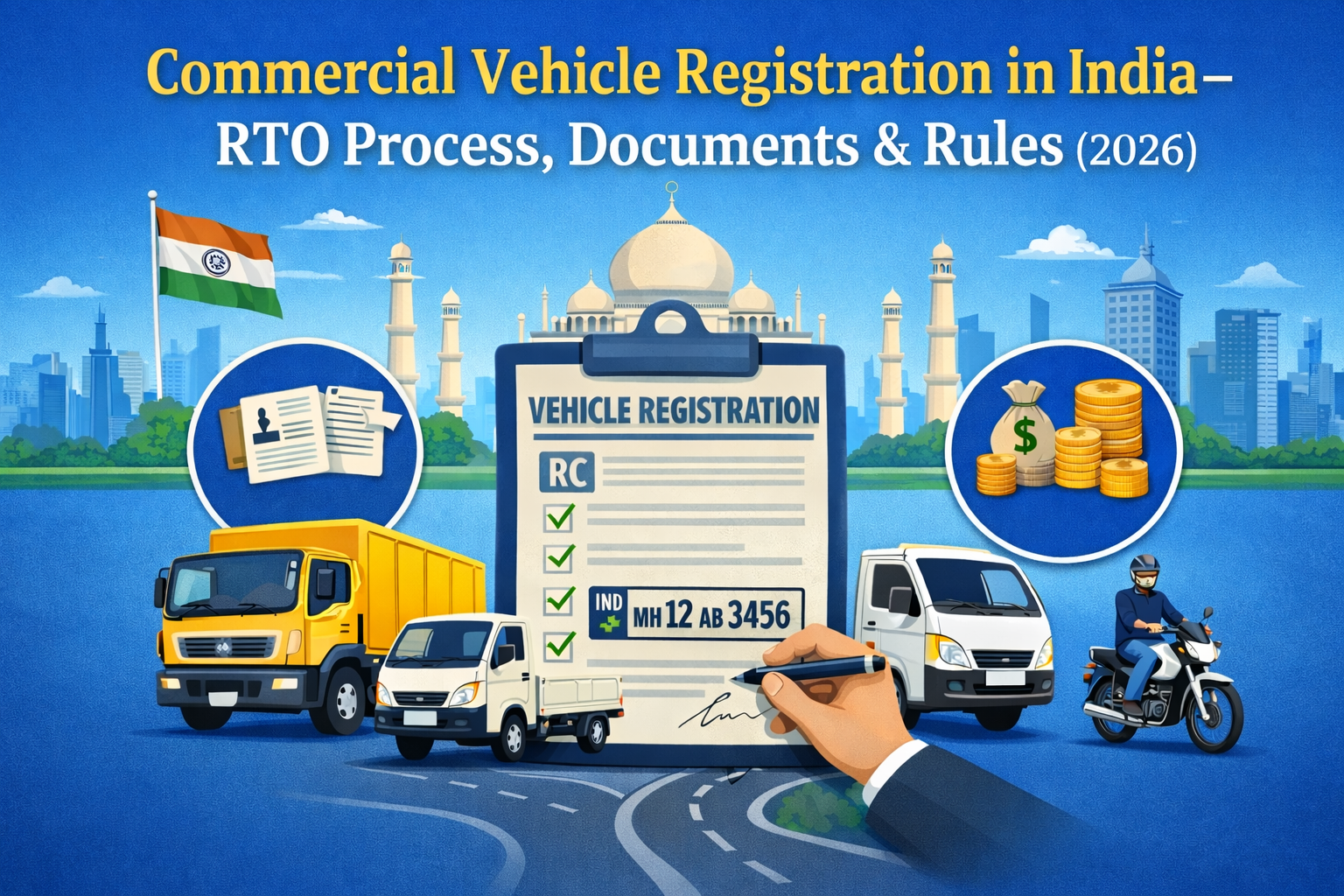

Planning to use a vehicle for deliveries, transport, or logistics in 2026? Then commercial vehicle registration is not just a formality; it’s a legal requirement that decides whether your vehicle can operate without fines or disruptions. Many vehicle owners focus on buying the right truck or loader but overlook the importance of completing registration correctly.
With logistics demand rising and more businesses using mini trucks, three-wheelers, and EV loaders, proper registration has become essential. Platforms like MOVER, which rely on fully compliant fleets, ensure that only registered vehicles complete deliveries smoothly without delays, checkpoints, or penalties.
This 2026 guide explains the complete registration steps, required commercial vehicle documents, permits, fitness rules, and road tax for commercial vehicles so owners can avoid mistakes and get their commercial RC approved quickly.
What is Commercial Vehicle Registration?
Commercial vehicle registration is the legal process of registering any goods or logistics vehicle with the Regional Transport Office (RTO). Once approved, the owner receives a commercial RC, which allows the vehicle to run for business, transport, or delivery services.
Commercial vehicles must follow stricter RTO rules for commercial vehicles, including:
-
Yellow number plates with black lettering
-
Mandatory HSRP (High Security Registration Plate)
-
Valid goods vehicle permit
-
Commercial vehicle fitness certificate
-
Road tax based on vehicle type and load
The commercial RC is valid for 5 years, and every renewal cycle also gives a 5-year validity, provided the vehicle passes fitness tests and meets emissions and safety norms.
Types of Vehicles That Need Commercial Registration
These vehicle types must complete logistics vehicle registration before operating for business:
-
Goods Vehicles (N1, N2, N3 Categories): Used for transporting cargo, including mini trucks, pickups, medium trucks, and heavy commercial vehicles.
-
Logistics & Delivery Vehicles: Includes e-commerce vans, courier vehicles, last-mile delivery autos, and city cargo carriers working in dense urban routes.
-
Transport Vehicles for Hire: Any vehicle earning revenue through goods movement must obtain a commercial RC and a valid goods vehicle permit.
-
Electric Commercial Vehicles: EV loaders, e-cargo autos, electric mini trucks, these use green number plates and often receive tax benefits in many states.
RTO Registration Process for Commercial Vehicles in 2026
Before the vehicle starts operations, the RTO registration process ensures it meets safety, emission, and compliance standards. Owners can register their vehicle offline at the RTO or through the official Parivahan portal.
Step-by-Step Offline RTO Registration Process
-
Submit Form 20, Form 21, Form 22, valid insurance, and identity/address proof at the Regional Transport Office.
-
Present the vehicle for inspection; the IMV checks chassis number, engine number, and roadworthiness.
-
RTO reviews documents and inspection results and begins processing the commercial RC.
-
Pay registration fees and road tax for commercial vehicles at the RTO counter.
-
Vehicle details are entered into the VAHAN database.
-
RTO approves the application, issues the commercial RC, and orders the HSRP.
Step-by-Step Online Registration Process – Parivahan Portal
-
Visit the official Parivahan portal and select Vehicle Registration Services.
-
Enter owner and vehicle details as per Form 20.
-
Upload necessary commercial vehicle documents including Forms 21 & 22, insurance, and invoice.
-
Pay registration charges and state-specific road tax online or at the RTO (varies by state).
-
Book a physical vehicle inspection appointment at the local RTO.
-
Present the vehicle for inspection by the RTO officer.
-
After approval, the commercial RC is issued, and the HSRP is processed.
Commercial Vehicle Documents Required for Registration
To complete commercial vehicle registration, the owner must submit all required documents during inspection or upload them to the Parivahan portal. Correct documents help avoid delays in issuing the commercial RC.
-
Form 20 – Application for Registration: This is the primary form containing the vehicle and owner details.
-
Form 21 – Sale Certificate: Provided by the dealer, confirming vehicle purchase details.
-
Form 22 – Roadworthiness Certificate: Issued by the manufacturer to certify the vehicle is safe for road use.
-
Valid Commercial Insurance: Commercial insurance is compulsory before RC approval.
-
Identity & Address Proof: Aadhaar, Passport, Voter ID, or any RTO-approved ID.
-
Pollution Under Control (PUC) Certificate: Required for all fuel-based vehicles before registration.
-
Temporary Registration (if applicable): Required when permanent registration is still in process.
-
Road Tax Payment Receipt: Proof of paying road tax for commercial vehicles, either online or at the RTO.
-
FASTag ID & VLT (Vehicle Tracking Device): Mandatory in most states for all transport-category vehicles.
Updated RTO Rules for Commercial Vehicles
These RTO rules for commercial vehicles must be followed in 2026 to avoid challans, delays, or legal restrictions:
-
Yellow Number Plates: All commercial vehicles must use yellow plates with black lettering, as mandated by MoRTH.
-
Mandatory HSRP + Colour-Coded Stickers: Every commercial vehicle must have an HSRP along with colour-coded stickers:
-
Blue – Petrol/CNG
-
Orange – Diesel
-
Green Strip – BS6-compliant vehicles
-
Correct Vehicle Classification (N1, N2, N3): Vehicles must be registered under the correct goods category:
-
N1: Light goods vehicles
-
N2: Medium goods vehicles
-
N3: Heavy commercial vehicles
-
Valid Goods Vehicle Permit: A state permit or national goods permit is compulsory for any vehicle transporting goods for business or hire.
-
Fitness Certificate Rules: Fitness rules are stricter and fully linked to RC validity:
-
New vehicles: FC valid for 2 years
-
Up to 8 years old: Renew every 2 years
-
Above 8 years old: Renew every year
-
After 10 years: Renewal fees increase significantly under Green Tax norms
From 2026:
-
All N3 (heavy commercial vehicles) must undergo testing at Automated Testing Stations (ATS).
-
Some N1 vehicles may still undergo manual checks if ATS is unavailable.
-
A commercial RC is legally valid only if the fitness certificate is valid.
-
Road Tax Compliance: Road tax for commercial vehicles must be paid quarterly, annually, or for 5 years, depending on state rules. Failure to pay leads to penalties or non-renewal of permits.
-
Speed Governors: Speed governors are mandatory for most N2 and N3 goods vehicles, with speed limits synced to VAHAN rules.
-
GPS / VLT Device Requirement: All commercial vehicles (except some small carriers) must have an AIS-140 certified GPS/VLT device with a panic button, linked to the state tracking server. RC will not be issued without an active device.
Common Mistakes to Avoid During Commercial Vehicle Registration
Avoiding these mistakes ensures faster approval of your commercial RC:
-
Incomplete or mismatched documents (like Form 21/22 or Aadhaar mismatch) can delay approval.
-
Registering the wrong class leads to permit issues and penalties.
-
Driving without temporary or permanent registration is illegal.
-
Delays result in penalties and stall the RC generation process.
-
Physical inspection is mandatory; missing the slot delays the application.
-
Must match Form 22 exactly to avoid rejection.
Conclusion
Completing commercial vehicle registration correctly ensures your truck, mini truck, electric loader, or delivery vehicle can operate legally without disruptions. When documents, permits, and fitness certificates are updated on time, vehicles move smoothly through checkpoints and avoid penalties.
Many owners who use logistics platforms like MOVER App rely on properly registered vehicles because they help maintain timely deliveries, prevent delays on routes, and keep operations compliant. A valid commercial RC simply makes your vehicle safe, legal, and fully ready for daily logistics use, whether you’re running city deliveries or long-distance transport.
FAQs – Commercial Vehicle Registration in India
1. Do I need a separate permit for interstate goods movement?
Yes. For travel across multiple states, a vehicle must have a national goods permit. A regular state permit only allows operation within that specific state.
2. Why is a commercial RC important?
A commercial RC is essential because a vehicle cannot legally operate for business without it. It is required for permits, fitness renewal, insurance claims, and compliance with RTO rules.
3. Do commercial vehicles need a goods vehicle permit?
Yes. Most commercial vehicles carrying goods require a valid goods vehicle permit. Depending on your business, you may need a state permit for local use or a national permit for interstate travel.
4. What is a commercial RC?
A commercial RC is the official Registration Certificate issued by the RTO for vehicles used to transport goods or operate for business purposes. It confirms the vehicle’s details, class, and commercial usage status.
5. Is a fitness certificate mandatory for commercial vehicles?
Yes, every commercial vehicle must have a valid fitness certificate. It confirms the vehicle is safe to operate. Fitness must be renewed periodically as per RTO rules for commercial vehicles.
6. How is road tax calculated for commercial vehicles?
Road tax for commercial vehicles is calculated based on multiple factors including vehicle weight, axle load, engine capacity, usage category, and state-specific rules. These factors determine the tax slab during registration and renewal.
7. Can commercial vehicle registration be done online?
Yes, parts of the RTO registration process can be completed online through the Parivahan portal, such as submitting documents, paying fees, and booking inspection appointments. However, physical vehicle inspection at the RTO is still mandatory.
8. What happens if a commercial vehicle is not registered?
Unregistered commercial vehicles can be fined, detained, or prohibited from operating. Insurance claims may also be rejected without proper registration or a valid commercial RC.
9. Is HSRP mandatory for commercial vehicles?
Yes. High Security Registration Plates and colour-coded stickers (for diesel/CNG in certain states) are mandatory for all commercial vehicles.
10. Can a commercial vehicle operate beyond 15 years?
Yes, but only if it passes the mandatory fitness test and meets all emission and safety requirements. Some states may restrict older commercial vehicles in highly polluted zones.