
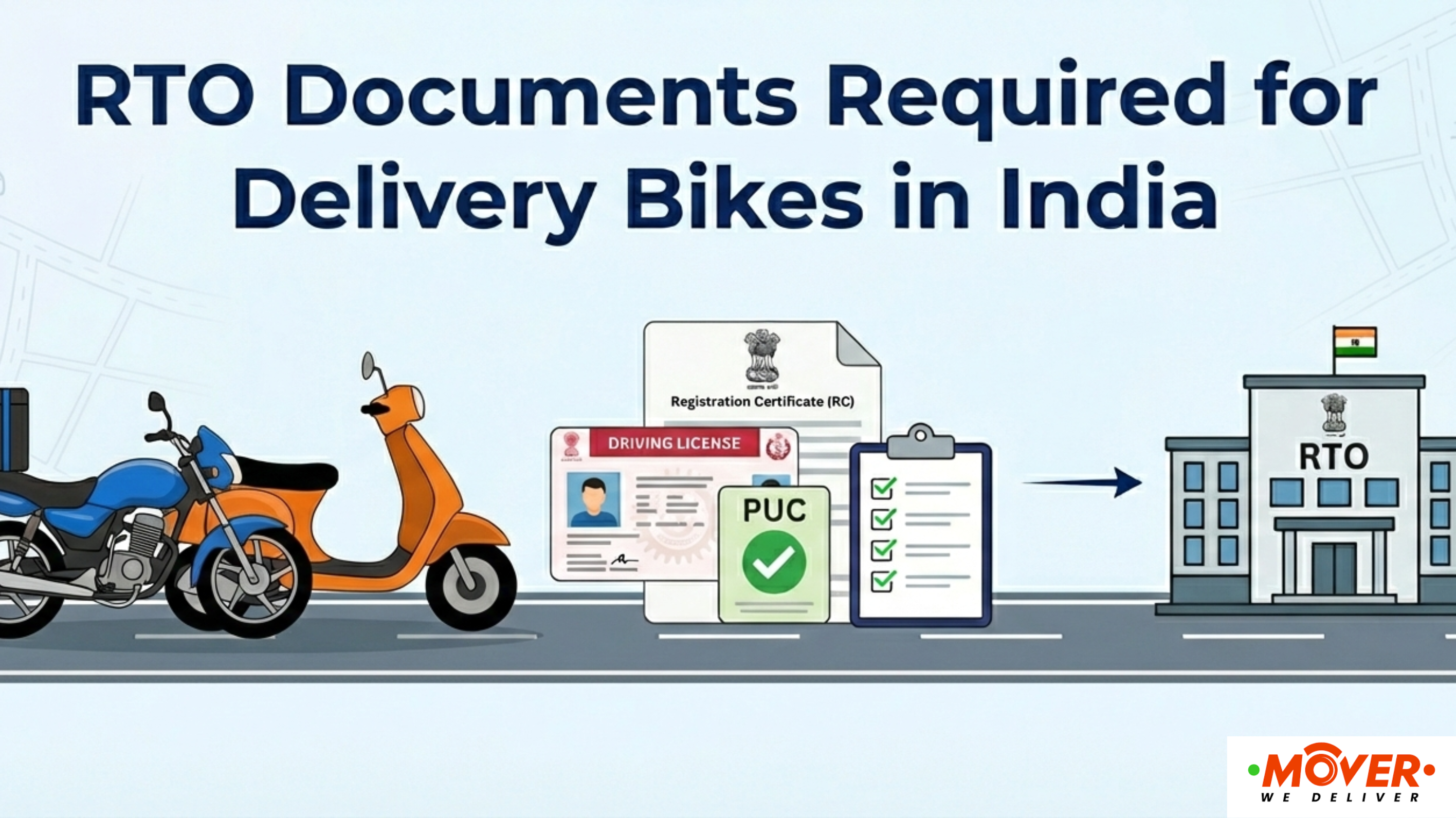

Understanding the RTO documents required for delivery bikes in India is essential for anyone using a two-wheeler for commercial delivery work. Whether you operate a food delivery scooter, courier bike, or e-commerce last-mile vehicle, proper documentation determines whether you can legally ride and earn.
As per RTO guidelines and transport rules, delivery bikes require specific commercial documentation, including Form 20, Form 21, Form 22, valid insurance, PUC certificate, and correct licence classification. A private registration or insurance policy does not legally cover commercial delivery usage. In 2026, enforcement has become stricter, with authorities verifying records digitally throughthe VAHAN and Sarathi systems.
Missing or incorrect documentation can lead to challans, insurance claim rejection, vehicle seizure, or platform suspension. This becomes especially critical for riders working through an organised logistics network, where compliance checks are routine. This guide explains the full delivery rider documents checklist required to stay compliant and operational.
Why Do Delivery Bikes Need Commercial Documentation?
Delivery bikes fall under the transport-category classification when used for income-generating activities. Under RTO rules for delivery bikes, commercial use completely changes the documentation requirements.
A bike used for personal commuting operates under non-transport registration. However, once the same bike is used for deliveries, it must comply with the commercial bike documents in India regulations. This includes commercial registration (where required), commercial insurance, a valid PUC, and the correct licence category.
The difference between private and commercial classification is not just about the number plate colour. It directly affects insurance validity, tax structure, and legal compliance. If a bike registered for private use is deployed for delivery work without updating its category, it may violate RTO norms, an issue many riders overlook when shifting from personal use to delivery operations.
With digital enforcement in 2026, mismatches between registration type and usage are quickly flagged during inspections.
Documents Required for Delivery of New Bike Registration
Here are some of the documents required for registering a new bike for delivery:
1. Form 20 – Application for Registration
Form 20 is the official RTO application form required to register a new delivery bike. It contains vehicle details, owner information, and usage category. For commercial registration, the correct transport classification must be selected to avoid compliance issues later.
2. Form 21 – Sale Certificate
Form 21 is issued by the dealer and confirms that the vehicle has been sold legally. It includes chassis number, engine number, and invoice details. This document is mandatory for both private and commercial two-wheeler documents.
3. Form 22 – Roadworthiness Certificate
Form 22 is issued by the manufacturer and certifies that the vehicle meets safety and emission standards. Without this certificate, the RTO will not approve registration.
4. Insurance Certificate
Delivery bike insurance requirements mandate at least third-party coverage at the time of registration. For commercial use, the policy must clearly mention commercial usage to remain valid during delivery operations.
5. Identity & Address Proof
Aadhaar, PAN, Passport, or Voter ID are accepted. These documents verify ownership and are mandatory for RC issuance.
6. PUC Certificate
PUC for delivery vehicles is compulsory before registration approval. Emission compliance is strictly checked during RTO processing.
7. Form 34 (If Financed)
If the bike is financed, Form 34 must be submitted to register the hypothecation details with the RTO.
|
Document |
Purpose |
Mandatory |
|
Form 20 – Application for Registration |
Official RTO application form containing vehicle details, owner information, and usage category. Commercial classification must be selected for delivery bikes. |
Yes |
|
Form 21 – Sale Certificate |
Issued by the dealer confirming legal sale. Includes chassis number, engine number, and invoice details. Required for both private and commercial registration. |
Yes |
|
Form 22 – Roadworthiness Certificate |
Manufacturer-issued certificate confirming safety and emission compliance. RTO will not process registration without it. |
Yes |
|
Insurance Certificate |
Must include at least third-party coverage. For delivery bikes, policy must clearly mention commercial usage to meet delivery bike insurance requirements. |
Yes |
|
Identity & Address Proof |
Aadhaar, PAN, Passport, or Voter ID used to verify ownership and issue the RC for delivery bike. |
Yes |
|
PUC Certificate |
Pollution Under Control certificate confirming emission compliance before registration approval. |
Yes |
|
Form 34 (If Financed) |
Required to record hypothecation details if the delivery bike is purchased through financing. |
Conditional (If financed) |
What is the Delivery Rider Documents Checklist?
Before starting delivery work, riders must ensure all delivery bike legal requirements are fulfilled. Keeping documents updated avoids fines, claim rejection, and operational delays.
-
Valid driving licence (commercial category if earning through deliveries)
-
Registration Certificate (RC) reflecting correct vehicle usage
-
Active commercial two-wheeler insurance policy
-
Valid PUC certificate (not required for electric bikes)
-
Identity and address proof
-
Permit, if applicable under state transport rules
-
Even a small mismatch between vehicle usage and registration category can create compliance issues during inspections.
What are the permit requirements for a delivery bike in India?
Permit rules depend on how the bike is classified under transport regulations.
-
Local city delivery bikes usually do not require a separate goods permit
-
Interstate movement may require additional transport endorsement
-
Commercial registration status influences permit applicability
-
State RTO guidelines may vary for two-wheelers
-
Digital verification through VAHAN makes compliance checks faster
If the bike is used purely for local last-mile deliveries, permit requirements are generally minimal, but classification must still be accurate.
RTO Rules for Electric Delivery Bikes
Electric delivery bikes must follow the same usage-based classification rules as petrol vehicles.
-
High-speed electric bikes (above 25 km/h or 250W) require RTO registration
-
Commercial electric bikes receive green number plates with yellow lettering
-
Commercial insurance remains mandatory
-
RC must reflect transport-category usage if used for delivery
-
Battery compliance documents are required at registration
-
No PUC required for electric vehicles
Electric status does not automatically exempt a vehicle from commercial compliance when it is used to earn income.
Final Verdict
Maintaining the correct RTO documents required for delivery bikes in India is not optional; it is the foundation of legal and uninterrupted delivery work. From registration forms and commercial insurance to PUC and driving licence compliance, every document plays a role in protecting your income.
In 2026, digital enforcement means authorities and platforms verify records instantly through the VAHAN and Sarathi systems. Delays in documentation can result in fines, downtime, rejected claims, or even temporary suspension from assignments.
For riders and fleet operators using an online truck booking app or managing deliveries through organised transport networks, documentation gaps can disrupt routes and booking confirmations. Structured systems that support online truck booking depend on verified RC, DL, insurance, and permit records to keep vehicles active.
Delivery partners working within logistics ecosystems like MOVER benefit from keeping documents updated and digitally accessible. Proper paperwork ensures compliance, protects earnings, and keeps delivery operations running smoothly without avoidable disruptions.
FAQ
1. What are the RTO documents required for delivery bikes in India?
Delivery bikes require a valid RC (commercial if used for income), driving licence, commercial insurance, PUC certificate, and identity proof. Commercial registration documents are mandatory for delivery use.
2. Is commercial registration mandatory for delivery bikes?
Yes. If the bike is used for earning income through deliveries, commercial registration is required under RTO rules for delivery bikes in India.
3. What documents are required for a delivery bike during traffic checks?
You must carry your driving licence, RC for delivery bike (commercial), valid insurance policy, and PUC certificate. Digital copies on DigiLocker or mParivahan are legally accepted.
4. Can I use a private RC for delivery work?
No. A private RC is meant for personal use only. Using it for deliveries can lead to fines, insurance claim rejection, and compliance issues.
5. What are the delivery bike insurance requirements in India?
Delivery bikes must have commercial two-wheeler insurance. Third-party insurance is mandatory, but comprehensive cover is recommended for protection against theft, accidents, and damage.
6. Is PUC mandatory for delivery vehicles?
Yes. A valid Pollution Under Control (PUC) certificate is compulsory for all delivery bikes and goods vehicles. It must be renewed periodically to avoid penalties.
7. What driving licence is required for a delivery bike?
A commercial two-wheeler driving licence is required for delivery work. A private licence may not be legally sufficient for regular commercial operations.
8. Are permits required for delivery bikes in India?
Generally, two-wheelers do not require separate goods permits like trucks. However, commercial registration and insurance compliance are mandatory under delivery bike legal requirements.
9. What documents are required for electric delivery bikes?
EV delivery bikes require Form 20, Form 21, Form 22, commercial insurance, RC, and battery compliance documents. Subsidy-related paperwork may also apply during registration.
10. What happens if delivery bike documents are incomplete?
Missing commercial two-wheeler documents can result in fines, vehicle seizure, insurance claim rejection, or temporary suspension from delivery platforms due to compliance violations.