
Choosing between Full Truck Load (FTL) and Part Truck Load (PTL) is one of the most important logistics decisions for businesses moving goods across India. While both are widely used transport models, selecting the wrong option can quietly increase freight costs, cause delivery delays, and raise the risk of transit damage.
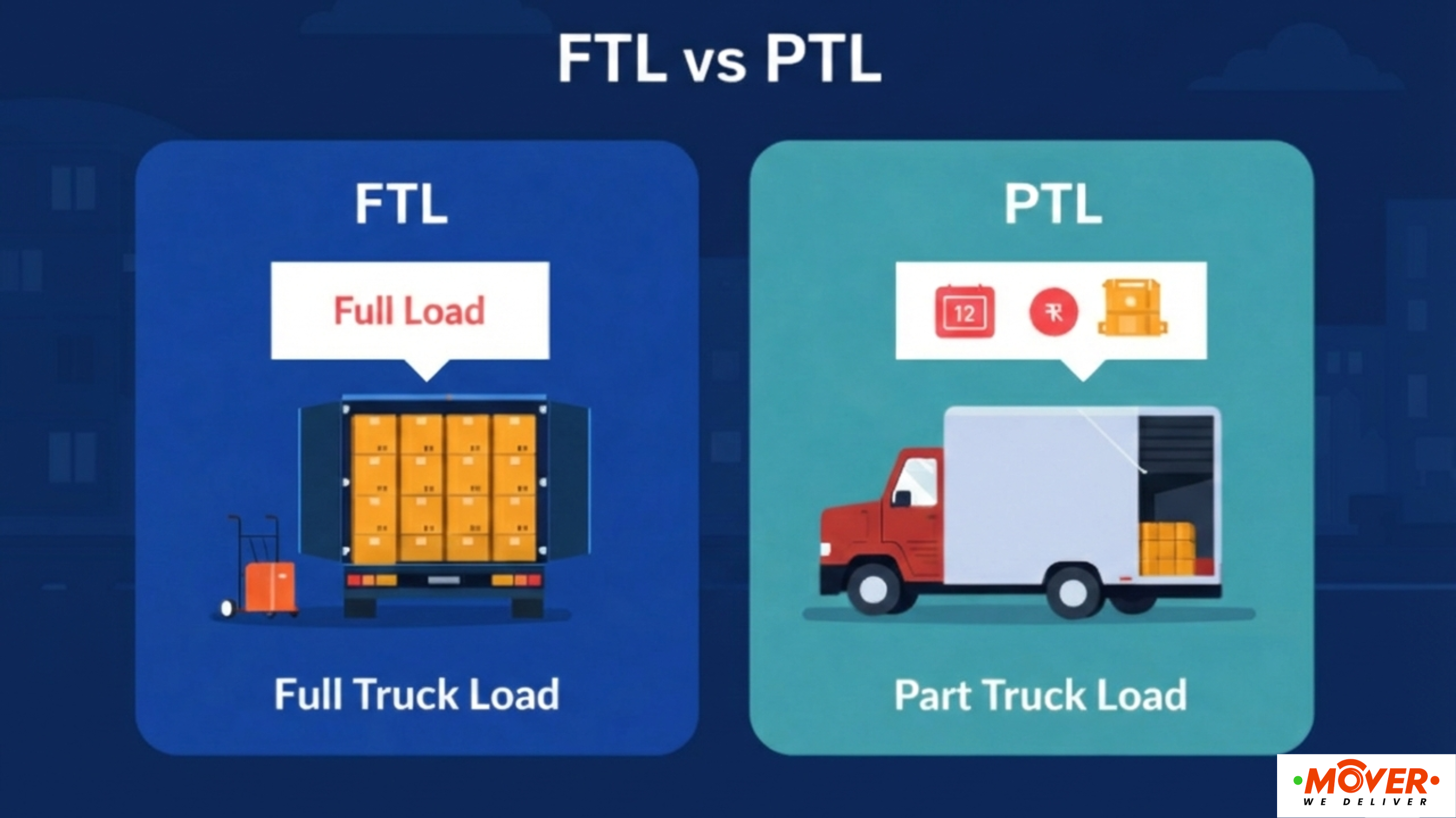
FTL means booking an entire truck for a single shipment, while PTL allows multiple shippers to share truck space. On paper, PTL often looks cheaper and FTL appears expensive, but operationally, the decision is more nuanced. Factors like shipment size, urgency, handling sensitivity, and route predictability play a major role in determining the true cost.
For SMEs, manufacturers, distributors, and logistics teams, this choice directly affects delivery timelines, inventory flow, and profitability. Businesses aiming to reduce logistics costs often overlook how mode selection impacts handling, returns, and hidden operational expenses.
This MOVER’s guide breaks down the difference between FTL and PTL in simple, practical terms, helping you choose the right option based on shipment size, cost efficiency, and delivery requirements in 2026.
What Is Full Truck Load (FTL)?
Full Truck Load (FTL) is a transport model where a single shipper books an entire truck exclusively for their cargo. The truck moves directly from the pickup point to the destination without sharing space with other shipments.
Because there are no intermediate stops or consolidations, FTL involves minimal handling, making it faster and more secure than shared transport. This direct movement significantly reduces the risk of transit damage and delays.
FTL is best suited for:
-
Your shipment fills most of the truck
-
Delivery timelines are strict or time-bound
-
Goods are fragile, high-value, or sensitive
-
Damage risk must be kept to a minimum
-
Routes and schedules are predictable
FTL is commonly used by manufacturers, wholesalers, and businesses moving bulk or priority consignments.
What Is Part Truck Load (PTL)?
Part Truck Load (PTL) is a shared transport model where multiple shippers use space within the same truck. Each shipment occupies only a portion of the vehicle, making PTL more cost-efficient for smaller loads.
PTL typically follows a hub-and-spoke movement. Goods are consolidated at hubs, transferred between vehicles, and then delivered to their final destinations. While this reduces cost per shipment, it increases handling and transit time.
PTL is best suited for:
-
Shipment volume is small or moderate
-
Delivery timelines are flexible
-
Cost control is a priority
-
Dispatches are regular but lightweight
-
Inventory turnover is slower
PTL is widely used by SMEs, regional sellers, and businesses with regular but lower-volume dispatches.
FTL vs PTL – Key Differences Explained
|
Factor |
Full Truck Load (FTL) |
Part Truck Load (PTL) |
|
Shipment Size |
Large / full capacity |
Small to mid-sized |
|
Cost Structure |
Higher upfront |
Lower per shipment |
|
Cost Efficiency |
Better at high volume |
Better at low volume |
|
Transit Time |
Faster, direct |
Slower, multiple stops |
|
Handling |
Minimal |
Multiple handovers |
|
Damage Risk |
Low |
Medium |
|
Flexibility |
Less |
High |
|
Best Use Case |
Bulk & urgent loads |
Regular small consignments |
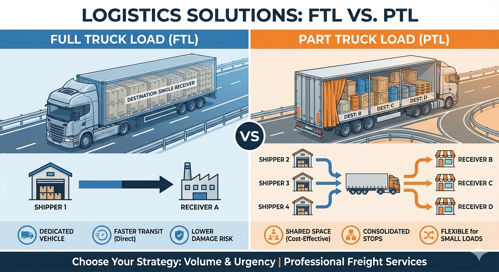
This comparison highlights why shipment size and urgency matter more than headline pricing when choosing between FTL and PTL.
FTL vs PTL Cost Comparison – Which Is Cheaper?
FTL often appears expensive because you pay for the entire truck, regardless of whether it is fully loaded. However, once a shipment occupies around 70 - 80% of truck capacity, FTL becomes more cost-efficient on a per-unit basis.
PTL, on the other hand, spreads transport costs across multiple shippers, making it cheaper for low-volume consignments. It is ideal when the shipment size is small, and timelines are flexible.
The mistake many businesses make is choosing PTL for large or urgent shipments, which leads to higher handling costs, delays, and sometimes returns. Strategic mode selection plays a key role in reducing logistics costs over time.
FTL vs PTL for Small vs Large Shipments
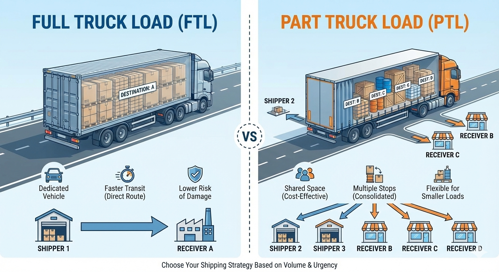
PTL is a practical choice for startups, SMEs, and regional sellers shipping smaller consignments across multiple locations. It keeps freight costs manageable without requiring full vehicle utilisation.
FTL, however, is better suited for manufacturers, distributors, and businesses handling seasonal surges or bulk movement. Large shipments moved via PTL often face higher cumulative handling, longer transit times, and increased damage risk.
Using PTL for fragile or urgent large shipments can backfire, leading to delays, inspection issues, and higher return rates. Matching shipment size to the correct transport mode is essential for operational efficiency.
Impact on Damage, Delays & Returns
-
More handling increases damage: PTL shipments pass through multiple hubs and handovers, increasing the risk of breakage, leakage, or packaging failure.
-
Higher delay probability: Multiple stopovers and consolidations in PTL make delivery timelines more vulnerable to congestion and scheduling issues.
-
Increased return rates: Damaged or delayed PTL shipments often lead to higher Return-to-Origin (RTO) and customer rejections.
-
FTL reduces uncertainty: Direct movement in FTL limits touchpoints, lowering damage risk and inspection delays.
-
Returns become costlier: Poor mode selection directly increases reverse logistics costs through re-handling, inspections, and re-routing.
FTL vs PTL in Modern Logistics Operations
In 2026, logistics networks rely heavily on mid-mile movement, consolidation hubs, and data-driven routing. PTL remains essential for network efficiency but is more sensitive to congestion and route complexity.
Urban congestion and last-mile bottlenecks often extend PTL timelines due to multiple stops and transfers. FTL benefits from predictable routing and fewer delays, especially on intercity corridors.
Aggregated fleets and structured routing systems help businesses plan shipment modes more accurately. This predictability allows logistics teams to align FTL and PTL usage with demand patterns rather than relying on guesswork.
Which is Better - Full Truck Load (FTL) or Part Truck Load (PTL)?
There is no universal winner between FTL and PTL—the right choice depends on the shipment context.
-
If volume is high and urgency matters, FTL delivers better cost efficiency, speed, and safety.
-
If cost control and flexibility matter more, PTL is the smarter option for smaller, non-urgent loads.
The key is not choosing the cheapest option upfront, but the most operationally efficient one. Businesses that align shipment size, urgency, and handling needs with the correct transport model see fewer delays, lower damage, and better overall logistics performance.
Final Verdict
Choosing between Full Truck Load and Part Truck Load is not just a pricing decision - it directly affects delivery reliability, damage rates, and return costs. PTL works best for smaller, flexible shipments, while FTL offers better control for large, urgent, or fragile loads. Businesses that align shipment size and urgency with the right transport mode see fewer delays and lower operational losses.
Delivery and logistics operators working through organised networks like MOVER - Truck Booking App, benefit when FTL and PTL decisions are planned correctly, as structured routing and verified fleets reduce damage, improve turnaround time, and keep logistics costs predictable at scale.
FAQs on FTL vs PTL
1. What is the difference between FTL and PTL?
FTL uses an entire truck for one shipment, while PTL shares truck space among multiple shipments. FTL is faster and safer; PTL is more cost-effective for small loads.
2. Is FTL cheaper than PTL?
FTL becomes cheaper per unit when the truck is mostly full. PTL is cheaper only for low-volume shipments.
3. Which is better for small shipments – FTL or PTL?
PTL is better for small shipments because it allows businesses to share truck space, reduce transport costs, and ship smaller volumes without paying for a full truck.
4. When should businesses choose FTL?
Businesses should choose FTL when shipment volumes are large, delivery timelines are strict, goods are fragile or high-value, and minimal handling is required to reduce damage risk.
5. Does PTL increase damage risk?
Yes, PTL generally increases damage risk because goods pass through multiple hubs, involve repeated loading and unloading, and experience more handling compared to direct FTL movement.
6. Which is faster: FTL or PTL?
FTL is faster because the truck moves directly from origin to destination without intermediate stops, consolidations, or hub delays, making it ideal for time-sensitive shipments.
7. Can PTL be used for fragile goods?
PTL can be used for fragile goods, but it carries higher risk due to multiple handovers. FTL is safer when protection, stability, and reduced handling are priorities.