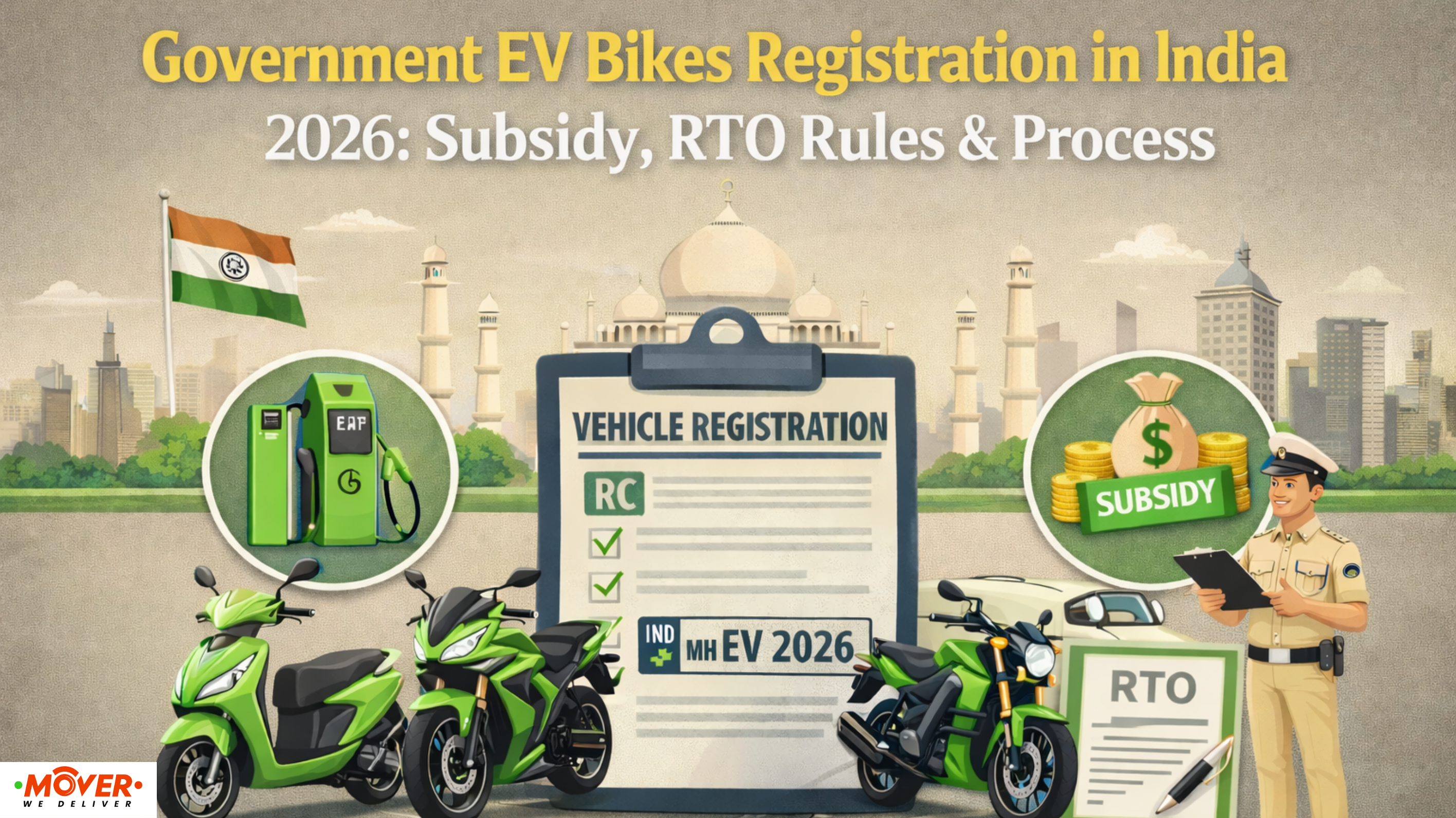

Is switching to electric delivery bikes just about saving fuel costs, or does EV registration play a bigger role than most people realise? In 2026, EV registration has become a critical step for anyone using electric bikes for delivery, logistics, or commercial transport. Without proper registration, permits, and subsidy compliance, even an electric vehicle can face fines, insurance issues, or operational restrictions.
With rising fuel prices and tighter emission norms, logistics companies and delivery partners are rapidly shifting toward electric bikes. Electric delivery fleets are now common across food delivery, e-commerce, and hyperlocal transport. Platforms like MOVER, which support day-to-day logistics operations, increasingly rely on registered and compliant electric delivery bikes to ensure smooth movement without delays at checkpoints or during inspections.
This 2026 guide explains everything delivery partners and fleet owners need to know, including EV registration rules, RTO requirements, electric vehicle subsidies, PM E-DRIVE updates, and state-wise EV benefits. Whether you’re registering a single delivery bike or managing a full electric delivery fleet, this guide will help you stay compliant, reduce costs, and avoid registration mistakes.
What is EV Registration and Why Does It Matter for Delivery Businesses?
EV registration is the official process of registering an electric vehicle with the Regional Transport Office (RTO) so it can legally operate on Indian roads. For the best mileage bikes used in logistics, EV registration confirms whether the vehicle is approved for commercial use, eligible for subsidies, and compliant with RTO rules.
For delivery partners, proper electric delivery bike registration ensures:
-
Legal operation for commercial deliveries
-
Eligibility for government subsidies and tax benefits
-
Valid insurance coverage during deliveries
-
Approval for green number plates is required for commercial EVs
Without correct EV registration, delivery bikes may face challans, insurance claim rejections, or restrictions in certain city zones. As logistics EV adoption increases in 2026, authorities are closely monitoring registration status, especially for bikes used in delivery fleets. That’s why EV registration is no longer optional; it’s a foundation for running electric delivery operations smoothly and legally.
Types of Electric Bikes Based on RTO Rules (2026)
Not all electric bikes follow the same EV registration rules. In India, the RTO clearly classifies electric two-wheelers based on speed and motor power, which directly affects registration, licensing, insurance, and delivery use.
1. Low-Speed Electric Bikes (LSEBs)
Low-speed electric bikes have a top speed of up to 25 km/h and a motor power not exceeding 250W. These vehicles are treated as non-motorised under current RTO rules.
Key points for delivery use:
-
EV registration required
-
Driving licence or insurance is mandatory
-
Not eligible for the central EV subsidy
-
Not allowed on highways or major expressways
-
Limited suitability for professional delivery fleets
While low-speed EVs may work for very short, local deliveries, most logistics businesses avoid them due to speed restrictions and operational limits.
2. High-Speed Electric Bikes (HSEBs)
High-speed electric bikes have a top speed above 25 km/h or a motor output over 250W. These bikes are fully classified as motor vehicles and must follow complete EV registration rules.
Key requirements:
-
Mandatory EV registration with RTO
-
Valid driving licence (minimum age 18)
-
Compulsory insurance
-
Green number plate issued
-
Eligible for PM E-DRIVE and state EV subsidies
-
Suitable for electric delivery bike registration and commercial use
Most delivery fleets, logistics partners, and platforms like MOVER prefer high-speed electric bikes because they meet speed, range, and compliance needs for daily delivery operations.
EV Bikes Registration Process in India (2026): Step-by-Step
In 2026, the EV registration process for electric delivery bikes is largely dealer-led and digital, but still includes mandatory RTO verification. Whether you’re buying one bike or adding multiple units to a delivery fleet, the steps remain mostly the same.
Step-by-Step EV Biks Registration Process
-
Vehicle Purchase from an Authorised Dealer: EV registration usually starts at the dealership. The dealer verifies whether the electric bike is approved under the PM E-DRIVE scheme and eligible for a subsidy.
-
Aadhaar-Based e-KYC & Parivahan Entry: The dealer uploads owner and vehicle details on the Parivahan portal using Aadhaar-linked authentication. This step is mandatory for subsidy-linked EV registration.
-
Document Upload & Verification: Required EV registration documents, such as invoice, insurance, identity proof, and battery details, are uploaded digitally for RTO verification.
-
Green Number Plate Allocation: Once approved, the RTO issues a green number plate. Commercial delivery bikes receive green plates with yellow lettering, as per green number plate rules.
-
RC Issuance: The electric vehicle RC (Registration Certificate) is generated digitally and later delivered as a smart card to the registered address.
For delivery partners and fleet owners, completing EV registration correctly ensures the bike can operate legally, claim subsidies, and avoid issues during inspections or insurance claims.
EV RTO Rules for Delivery Bikes & Commercial Use
Electric bikes used for deliveries must follow specific EV RTO rules for delivery bikes, especially when registered for commercial purposes. In 2026, enforcement has become stricter as electric delivery fleets expand across cities.
Commercial EV Registration Rules
-
Electric delivery bikes must be registered under commercial use, not private use.
-
A green number plate with yellow lettering is mandatory for commercial electric bikes.
-
Using a privately registered EV for paid deliveries can lead to fines or insurance rejection.
Licence & Insurance Requirements
-
Riders must hold a valid driving licence (minimum age 18) for high-speed electric bikes.
-
Third-party insurance is compulsory; comprehensive insurance is strongly recommended for delivery fleets.
EV Permit for Commercial Use
-
In most cities, electric delivery bikes do not require a separate goods vehicle permit like trucks.
-
However, local municipal rules may restrict operating zones or delivery timings, especially in high-traffic areas.
Fitness & Operational Compliance
-
Electric delivery bikes may require periodic checks if registered as commercial vehicles, depending on state rules.
-
Helmets, reflective jackets, and speed compliance are mandatory during deliveries.
For logistics businesses and platforms like MOVER, following these EV RTO rules ensures uninterrupted operations, smooth onboarding of delivery partners, and zero legal risk during city inspections.
EV Subsidy in India: PM E-DRIVE & State-Wise Benefits
In 2026, the central government subsidy for electric two-wheelers has shifted from FAME II to the PM E-DRIVE scheme. This change directly impacts the cost of electric delivery bikes used in logistics and last-mile operations.
1. Central Government Subsidy – PM E-DRIVE Scheme (2026)
The PM E-DRIVE scheme is active until 31 March 2026 and offers an upfront incentive at the time of purchase.
Key points:
-
Subsidy of ₹2,500 per kWh of battery capacity
-
Maximum benefit capped at ₹5,000 per vehicle or 15% of the ex-factory price, whichever is lower
-
Applied directly as a discount on the invoice by authorised dealers
-
Aadhaar-based e-KYC is mandatory
-
Applicable to both private and commercial electric bikes, including delivery bikes
-
Vehicles must meet performance criteria such as minimum range and top speed
Delivery partners planning EV registration should confirm that their chosen model is PM E-DRIVE approved before purchase.
2. State-Wise EV Subsidy 2026 (Additional Benefits)
Along with the central subsidy, many states offer extra incentives under their Electric Vehicles Policy, making electric delivery bikes more affordable.
Common state-level benefits include:
-
100% or partial exemption on road tax
-
Waiver of registration fees
-
Additional cash incentives in select states
Examples:
-
Tamil Nadu & Telangana: Full road tax and registration fee exemption for EVs
-
Gujarat: Reduced road tax and registration charges (policy valid till 2026 in many cases)
Most buyers can combine the PM E-DRIVE subsidy with state incentives, significantly reducing the overall cost of EV registration and ownership.
EV Registration Documents Required
To complete EV registration smoothly in 2026, delivery partners and fleet owners must submit a specific set of documents during purchase or RTO verification. Missing or incorrect documents are one of the most common reasons for registration delays.
Mandatory Documents for EV Registration
-
Sales Invoice: Issued by the dealer, showing vehicle price, battery details, and subsidy (if applied).
-
Form 21 (Sale Certificate): Confirms ownership transfer from dealer to buyer.
-
Form 22 (Roadworthiness Certificate): Certifies that the electric bike meets safety and emission standards.
-
Valid Insurance Policy: At least third-party insurance is compulsory for electric delivery bikes.
-
Identity & Address Proof: Aadhaar, Passport, Voter ID, or other RTO-approved documents.
-
Aadhaar-Linked Mobile Number: Required for e-KYC and subsidy processing under PM E-DRIVE.
-
Battery Compliance Documents: Confirms advanced battery technology eligibility for subsidy.
-
FASTag (if applicable): Mandatory for many commercial EVs, depending on state rules.
For fleet owners registering multiple delivery bikes, dealers usually handle document uploads through the Parivahan portal, making the EV registration process faster and more organised.
Green Number Plate Rules Explained
Green number plates are mandatory for all registered electric vehicles in India. These plates help authorities easily identify EVs and apply the correct benefits, exemptions, and compliance checks during inspections.
Types of Green Number Plates
-
Green plate with white lettering: Issued to privately registered electric bikes used for personal travel. These vehicles are not legally allowed to perform paid delivery or logistics work.
-
Green plate with yellow lettering: Issued to commercial electric bikes, including electric delivery bikes used in logistics. This plate clearly indicates commercial use and is required for delivery fleets and partners.
Why Green Number Plates Matter for Delivery Bikes
For delivery partners, the correct green number plate:
-
Confirms legal commercial use
-
Helps avoid fines during traffic checks
-
Ensures insurance remains valid during deliveries
-
Allows access to EV-related benefits and city-level incentives
Using a private green plate for commercial deliveries can result in penalties or insurance claim rejection. That’s why electric delivery bike registration with the correct green plate is essential for logistics operations in 2026.
EV Registration vs Petrol Bike Registration (Key Differences)
Understanding the difference between EV registration and petrol bike registration helps delivery partners and fleet owners make better long-term decisions in 2026. While both follow basic RTO procedures, electric vehicles come with added benefits and different compliance rules.
1. Registration & Cost - Petrol bikes require standard RTO registration along with road tax and registration fees. In contrast, electric delivery bike registration often comes with road tax exemptions and registration fee waivers, depending on the state’s EV policy.
2. Subsidy & Incentives - Petrol bikes do not qualify for any government incentives. Electric bikes, however, are eligible for PM E-DRIVE subsidy and additional state-wise EV subsidies, significantly reducing upfront costs.
3. Number Plate & Compliance - Petrol delivery bikes use yellow number plates for commercial use. Electric delivery bikes must use green number plates with yellow lettering, clearly identifying them as commercial EVs.
4. Operating Cost & Business Use - Electric bikes have lower running and maintenance costs, making them ideal for delivery fleets and logistics EV adoption. For businesses using platforms like MOVER, EVs offer better long-term savings and easier compliance compared to petrol bikes.
Logistics EV Adoption & Electric Delivery Fleets
In 2026, logistics EV adoption is no longer experimental—it’s a practical shift driven by rising fuel costs, tighter emission rules, and city-level restrictions on petrol vehicles. Electric delivery bikes are now widely used across food delivery, e-commerce, pharmacy logistics, and hyperlocal transport.
For delivery fleets, EV registration plays a key role in scaling operations. Registered electric bikes with proper commercial status, green number plates, and insurance can operate without interruptions during traffic checks or audits. Many fleet operators are also attracted by lower running costs, fewer maintenance issues, and access to government subsidies.
Logistics platforms like MOVER increasingly work with delivery partners who use compliant electric bikes. Registered EV fleets help ensure smooth onboarding, predictable delivery timelines, and reduced regulatory risk. As cities push for cleaner transport, properly registered electric delivery fleets are becoming the preferred choice for last-mile logistics in 2026.
Common Mistakes to Avoid During EVBikes Registration
Many delivery partners and fleet owners face delays or penalties not because EV registration is complex, but because of small, avoidable mistakes. Knowing these in advance helps ensure faster approval and smooth operations.
-
Buying a non-approved EV model: Not all electric bikes qualify for PM E-DRIVE or state subsidies. Always check approval status before purchase.
-
Confusing low-speed and high-speed rules: Low-speed EVs don’t need registration, but are often unsuitable for commercial deliveries due to speed and route restrictions.
-
Incorrect registration category: Using a privately registered EV for paid deliveries can lead to fines and insurance claim rejection.
-
Wrong number plate type: Delivery bikes must use green plates with yellow lettering for commercial use.
-
Missing Aadhaar-linked e-KYC: Subsidy-linked EV registration requires Aadhaar authentication.
-
Ignoring state-specific rules: EV subsidy and road tax benefits vary by state and often have expiry deadlines, especially in 2026.
Avoiding these mistakes ensures your electric delivery bike is legally compliant, subsidy-eligible, and ready for daily logistics work.
Conclusion
EV registration in 2026 is no longer complicated, but it does require clarity on RTO rules, subsidies, and correct vehicle classification. For delivery partners and fleet owners, registering electric delivery bikes the right way ensures legal operations, access to government incentives, and long-term cost savings.
With schemes like PM E-DRIVE, state-level EV subsidies, and green number plate benefits, electric bikes are becoming a practical choice for logistics. Platforms like MOVER, which work with compliant delivery fleets, rely on properly registered EVs to avoid route delays and operational issues. In simple terms, correct EV registration helps delivery businesses stay compliant, reduce costs, and scale sustainably in 2026.
FAQs - EV Registration, Subsidy & Delivery Use
1. Is EV registration mandatory for all electric bikes in India?
No. Only high-speed electric bikes (above 25 km/h or 250W motor power) require EV registration. Low-speed electric bikes are exempt but are not suitable for most delivery operations.
2. Can electric delivery bikes get a government subsidy in 2026?
Yes. Eligible electric delivery bikes can receive the PM E-DRIVE subsidy along with applicable state-wise EV subsidies, provided the model meets performance and battery criteria.
3. What is the difference between private and commercial EV registration?
Private EVs use green plates with white lettering and cannot be used for paid deliveries. Commercial electric delivery bikes must be registered for business use and use green plates with yellow lettering.
4. Is insurance compulsory for electric delivery bikes?
Yes. All high-speed electric bikes used for delivery must have at least third-party insurance. Without insurance, the vehicle cannot legally operate.
5. Do electric delivery bikes need a permit for commercial use?
In most cities, electric delivery bikes do not require a separate goods permit. However, local municipal or traffic rules may restrict operating zones or timings.
6. What documents are required for EV registration in 2026?
Common documents include the sales invoice, insurance certificate, Aadhaar-linked ID, dealer certificate, battery compliance documents, and road tax receipt (if applicable).
7. When does the PM E-DRIVE subsidy end?
The central PM E-DRIVE subsidy for electric two-wheelers is currently valid until March 31, 2026. Timely purchase and registration are important to claim benefits.
8. Are EVs cheaper to run than petrol bikes for delivery?
Yes. Electric delivery bikes have much lower running and maintenance costs, making them more cost-effective for daily logistics and fleet operations.