
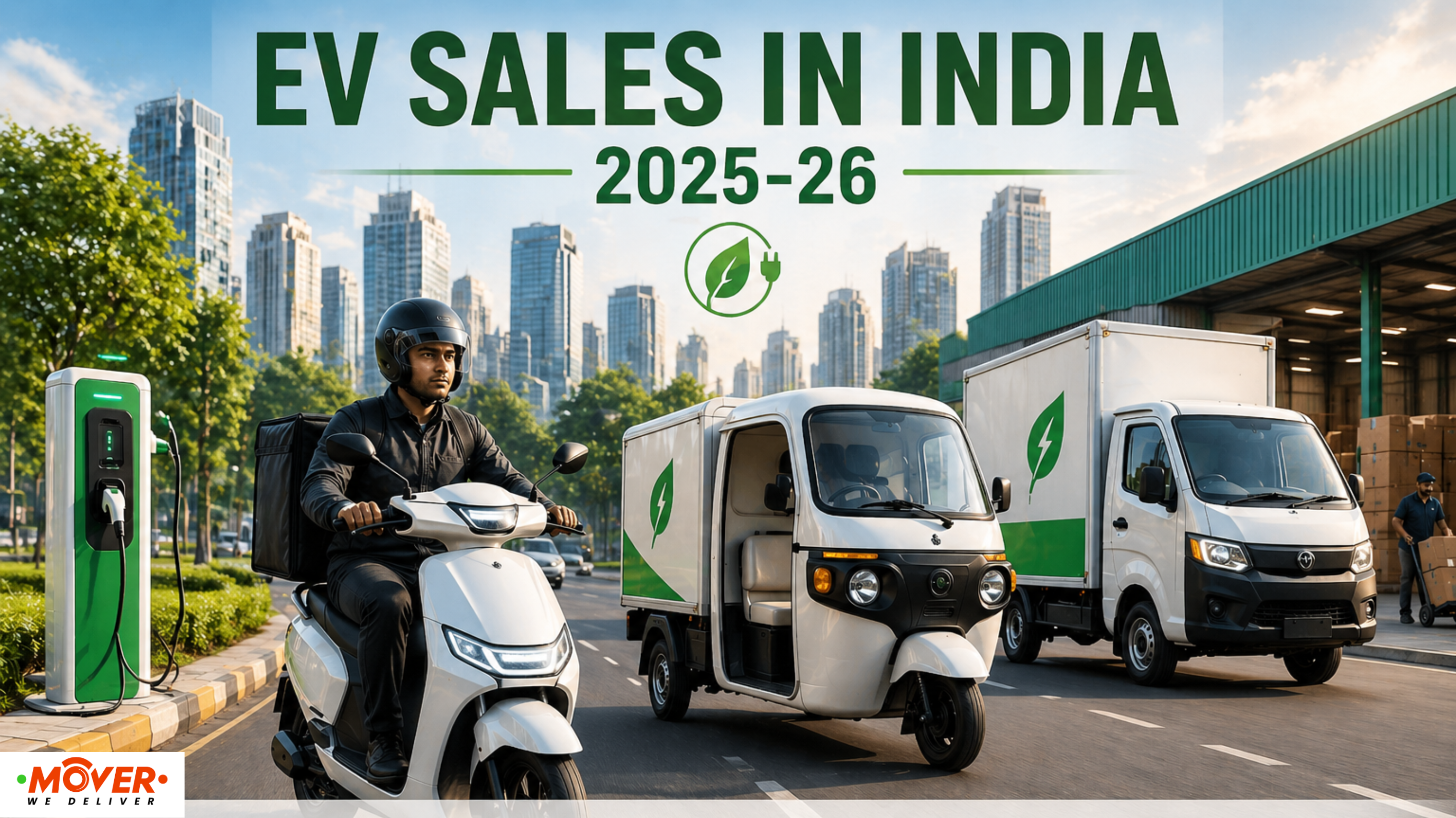

India’s electric mobility journey has entered a defining phase, with EV sales in India 2025-26 reaching record-breaking levels. What was once a niche segment is now transforming into a mainstream mobility solution, driven by rising fuel costs, government support, and growing demand for sustainable transportation.
In FY2025–26, India’s electric vehicle market crossed approximately 24.5 lakh units, marking a strong 24.6% year-on-year growth, with overall EV penetration reaching around 8.5%. These numbers highlight how rapidly the EV market India 2026 is expanding across segments.
More importantly, this growth is not just about personal mobility. Electric two-wheelers and three-wheelers are dominating adoption, especially in urban areas, making them crucial for last mile delivery EV India and logistics operations. At the same time, electric commercial vehicles are witnessing accelerated growth, pushing businesses toward fleet electrification.
This article explores how this record year is reshaping, influencing costs, operations, and the future of delivery businesses.
Executive Summary
-
Record EV Sales in India (FY2025–26): India’s EV market recorded a major milestone with 24.5 lakh units sold in FY2025–26, reflecting a strong growth trajectory. This surge highlights how EV adoption is moving from early-stage adoption to mainstream mobility across multiple segments.
-
Strong Growth with Increasing Penetration: The market grew by approximately 24.6% year-on-year, with overall EV penetration reaching around 8.5%. This indicates a steady shift toward electric mobility across both personal and commercial transportation.
-
Two-Wheelers Leading EV Adoption: Electric two-wheelers continue to dominate the market, contributing the largest share of total EV sales. Their affordability and suitability for urban commuting make them the primary driver of EV growth in India.
-
Commercial EV Segment Expanding Rapidly: Electric commercial vehicles have seen significant growth, with sales more than doubling in FY2025–26. This reflects increasing adoption among businesses, especially in logistics and delivery operations.
-
Logistics Industry Accelerating EV Adoption: Logistics and delivery companies are rapidly shifting toward EV fleets to reduce operational costs and improve efficiency. This shift is transforming how last-mile delivery operates in urban areas.
-
Infrastructure and Policy Support Driving Growth: Expansion of charging infrastructure and supportive government policies are enabling faster EV adoption. These developments are making it easier for businesses to transition toward electric mobility.
EV Sales in India 2025–26
-
Total EV Sales Cross 24.5 Lakh Units: In FY2025–26, EV sales in India 2025-26 reached approximately 24.5 lakh units, marking a record year for the industry. This milestone reflects the rapid expansion of the EV market India 2026, driven by increasing consumer demand and wider product availability.
-
Year-on-Year Growth of Over 24%: The EV market recorded a 24.6% year-on-year growth, highlighting strong momentum across all segments. This consistent growth trend indicates that electric mobility is no longer limited to early adopters but is steadily becoming a mainstream transportation choice.
-
EV Penetration Reaches 8.5%: India’s EV penetration reached approximately 8.5% in FY2025–26, showing a gradual but steady increase in adoption. This rise reflects improving consumer confidence, better infrastructure, and stronger policy support across the country.
-
Market Growth Driven by Multiple Segments: The growth in EV sales is not limited to one category. While two-wheelers dominate volumes, three-wheelers and commercial vehicles are contributing significantly to overall market expansion, making the ecosystem more balanced and scalable.
-
Shift Toward Scalable Electric Mobility: The consistent rise in sales and penetration indicates a shift from experimental adoption to large-scale deployment. Businesses, especially in logistics, are now actively integrating EVs into their operations, aligning with long-term cost and sustainability goals.
Electric Vehicle Retail Sales in India (Monthly Data)
|
Year |
FY2026 |
FY2025 |
% Change (FY 26 vs FY 25) |
|
Apr |
1,69,335 |
1,15,969 |
46% |
|
May |
1,81,435 |
1,40,668 |
29% |
|
Jun |
1,81,809 |
1,40,141 |
30% |
|
Jul |
1,90,376 |
1,80,185 |
6% |
|
Aug |
1,88,772 |
1,57,295 |
20% |
|
Sep |
1,84,407 |
1,60,501 |
15% |
|
Oct |
2,36,780 |
2,19,746 |
8% |
|
Nov |
2,19,034 |
1,93,145 |
13% |
|
Dec |
2,04,263 |
1,43,148 |
43% |
|
Jan |
2,20,731 |
1,71,295 |
29% |
|
Feb |
1,95,866 |
1,40,170 |
40% |
|
Mar |
2,80,093 |
2,05,284 |
36% |
|
Total |
24,52,921 |
19,67,547 |
25% |
(Source: https://www.autocarpro.in)
EV Retail Sales in FY2025 (Segment-wise)
|
Segment |
Units |
% Share of EV Market |
|
e-2Ws |
11,50,781 |
58.48% |
|
e-3Ws |
6,98,914 |
35.52% |
|
e-PVs |
1,08,682 |
5.52% |
|
e-CVs |
8,840 |
0.44% |
|
Misc |
330 |
— |
|
Total |
19,67,547 |
100% |
(Source: https://www.autocarpro.in)
Segment-wise EV Growth in India: 2025-26
India’s EV growth in FY2025–26 is driven by different vehicle segments, each contributing uniquely to overall adoption. While two-wheelers dominate in volume, three-wheelers and commercial vehicles are playing a crucial role in expanding electric mobility across logistics and passenger transport. This growth is part of the broader Electric Vehicle Industry in India, which continues to evolve rapidly across segments.
EV Retail Sales in FY2026 (Segment-wise)
|
Segment |
Units |
YoY Growth |
% Share of EV Market |
|
e-2Ws |
14,02,138 |
Up 22% |
57.16% |
|
e-3Ws |
8,30,818 |
Up 19% |
33.87% |
|
e-PVs |
1,99,590 |
Up 84% |
8.15% |
|
e-CVs |
19,648 |
Up 122% |
0.80% |
|
Misc |
727 |
— |
— |
|
Total |
24,52,921 |
Up 25% |
100% |
(Source: https://www.autocarpro.in)
Electric Two-Wheeler Sales India 2026
Electric two-wheelers continue to lead the market, accounting for nearly 58% of total EV sales in FY2025–26. Their affordability, low running cost, and suitability for short-distance travel make them the most widely adopted EV category.
The growth in electric two wheeler sales India 2026 is largely driven by urban commuters and delivery riders, making them essential for last-mile operations. This segment is also dominated by the Top EV Brands in India, which are driving innovation and adoption.
Electric Three-Wheeler India 2026
Electric three-wheelers have emerged as one of the fastest-growing segments, especially in both passenger and cargo categories. This segment is widely used for short-distance transport and goods movement, making it highly relevant for logistics. The rise of electric three wheeler India 2026 reflects increasing adoption among small businesses and fleet operators looking for cost-effective alternatives.
Electric Commercial Vehicles
Electric commercial vehicles recorded over 100% growth in FY2025–26, making them one of the fastest-expanding segments in the EV ecosystem. With more than 19,000 units sold, this category is gaining traction among logistics companies and fleet operators. This shift is closely linked to the growing demand for electric cargo vehicles in India, especially for urban delivery operations where efficiency and cost savings are critical.
Impact of EV Sales Growth on Logistics & Delivery Businesses
The surge in EV sales in India 2025-26 is not just a market milestone; it is fundamentally transforming how logistics and delivery businesses operate. This shift is closely connected to the broader Electric Vehicle Industry in India, where rapid adoption is driving operational and cost efficiencies across sectors.
1. Rapid Fleet Electrification Across Logistics Companies
Logistics companies and e-commerce platforms are accelerating the transition to electric fleets, especially two-wheelers and three-wheelers. The strong growth in EV adoption has pushed businesses to move beyond pilot projects and adopt EVs at scale. This trend aligns with the rise of last mile delivery EVs in India, where speed and cost efficiency are critical.
2. Significant Reduction in Operating Costs (TCO Advantage)
One of the biggest advantages of EV adoption is the reduction in Total Cost of Ownership (TCO). Electric vehicles eliminate fuel expenses and have lower maintenance costs compared to traditional vehicles. This is helping logistics companies reduce logistics costs, especially in high-frequency delivery operations.
3. Rise of Last-Mile Delivery EV India
Electric two-wheelers and three-wheelers are becoming the backbone of urban delivery systems. Their ability to operate efficiently in dense city environments makes them ideal for quick deliveries. Many businesses that previously relied on petrol vehicles or even best mileage bikes for delivery are now shifting toward EVs for better long-term savings.
4. Expansion of EV Logistics India Ecosystem
The rapid growth of EV adoption is driving the expansion of the EV logistics India ecosystem, including fleet operators, leasing companies, and EV service providers. Businesses are increasingly adopting fleet-as-a-service models to scale efficiently and manage upfront costs.
5. Growth of Electric Cargo Vehicles in Urban Delivery
The demand for electric cargo vehicle India is rising significantly, especially in urban logistics. Fleet operators are also evaluating vehicle categories like SCV vs LCV vs HCV vehicles to optimise delivery efficiency and choose the right EV for different use cases.
6. Charging Infrastructure Supporting Logistics Growth
The expansion of public charging infrastructure is playing a critical role in enabling EV adoption. Charging networks have grown rapidly, supporting delivery routes and reducing range anxiety for fleet operators.
Why Logistics Companies Are Switching to EVs?
The rapid growth in EV sales in India 2025-26 is pushing logistics companies to rethink their operations. What was once a cost-driven decision is now becoming a strategic shift, driven by efficiency, sustainability, and long-term scalability.
1. Lower Fuel Costs and Higher Savings
Fuel is one of the biggest expenses in logistics operations. By switching to electric vehicles, companies can significantly reduce fuel dependency and stabilise operating costs. This shift is especially beneficial for high-frequency delivery routes, where even small savings per trip can lead to substantial long-term cost advantages.
2. Reduced Maintenance and Better Efficiency
Electric vehicles have fewer moving parts compared to traditional vehicles, which results in lower maintenance requirements. This improves fleet uptime and reduces downtime caused by repairs, helping logistics businesses maintain consistent delivery performance.
3. Strong Push Toward Last-Mile Efficiency
The demand for faster deliveries has increased the importance of last-mile optimisation. Electric vehicles, particularly two-wheelers and three-wheelers, are well-suited for last mile delivery EV India, enabling faster and more efficient deliveries in congested urban environments.
4. Sustainability and Regulatory Compliance
With increasing focus on reducing carbon emissions, companies are adopting EVs to meet sustainability goals and comply with government regulations. Policies like the Delhi EV Policy 2026 Draft are encouraging businesses to transition toward cleaner mobility solutions.
5. Scalability Through Fleet Models and Leasing
Many logistics companies are adopting leasing and fleet-as-a-service models to scale EV adoption without heavy upfront investment. This approach allows businesses to expand operations quickly while managing costs effectively.
Role of Electric Cargo Vehicles in Delivery
While the growth in EV sales in India 2025-26 is transforming logistics, the transition is not without challenges. Businesses still face several operational and financial barriers when shifting from traditional fleets to electric mobility.
-
Limited Charging Infrastructure in Some Areas: Although charging networks are expanding, availability is still uneven, especially in smaller cities and along long delivery routes. This creates operational challenges for logistics companies that rely on consistent vehicle uptime and route flexibility.
-
High Upfront Cost of EVs: Electric vehicles typically have a higher initial purchase cost compared to petrol or diesel vehicles. Despite long-term savings, this upfront investment can be a barrier for small businesses and fleet operators looking to scale quickly.
-
Fleet Transition and Operational Adjustment: Switching to EVs requires changes in fleet management, route planning, and driver training. Logistics companies need to adapt their operations to accommodate charging time and battery management, which can initially impact efficiency.
-
Battery Lifecycle and Replacement Costs: Battery degradation over time remains a concern for businesses operating large fleets. Replacement costs and performance consistency can impact long-term planning, especially for companies relying heavily on continuous delivery operations.
EV Penetration in India 2026 – What It Means?
The strong growth in EV sales in India 2025-26 signals that electric mobility is no longer optional for logistics businesses; it is becoming a core part of future operations. As adoption increases, the EV logistics India ecosystem is expected to expand rapidly, driven by technology, infrastructure, and policy support.
1. Large-Scale Fleet Electrification Ahead
Logistics companies are expected to accelerate EV adoption across fleets, especially in two-wheelers, three-wheelers, and small commercial vehicles. What started as pilot programs is now scaling into a full fleet transformation, particularly in urban delivery networks.
2. Expansion of Charging Infrastructure
Charging infrastructure will continue to grow, improving accessibility for logistics routes and reducing operational constraints. This expansion will make EVs more viable for long-distance and high-frequency delivery operations.
3. Growth of Electric Cargo Vehicles
The demand for electric cargo vehicle India will increase as businesses look for efficient alternatives for goods transport. Electric three-wheelers and compact commercial EVs will play a major role in urban logistics.
4. Technology and Data-Driven Fleet Management
Advanced fleet management tools, route optimisation, and battery monitoring systems will enhance efficiency in EV logistics. These technologies will help businesses improve delivery timelines and reduce operational inefficiencies.
5. Stronger Policy Support and Incentives
Government policies and incentives will continue to support EV adoption, making it easier for businesses to transition. Initiatives under the Electric Vehicle Industry in India are expected to further boost infrastructure and manufacturing.
Challenges in EV Adoption for Logistics
While the growth in EV sales in India 2025-26 is transforming logistics, the transition still comes with operational challenges. These issues are part of the broader evolution of the Electric Vehicle Industry in India, where infrastructure and cost barriers are gradually being addressed.
1. Charging Infrastructure Gaps
Despite rapid expansion, the charging infrastructure is still uneven across regions, especially in tier-2 cities and on highways. Logistics operations require predictable charging access, and limited availability can disrupt delivery schedules. This makes route planning more complex and restricts large-scale EV deployment for long-distance logistics operations.
2. High Upfront Cost of EVs
Electric vehicles generally have higher upfront costs compared to petrol or diesel alternatives. While long-term savings are significant, the initial investment can be a challenge for small fleet operators. This slows down adoption, particularly for businesses that require immediate returns on investment.
3. Fleet Transition and Operational Challenges
Shifting from traditional vehicles to EVs requires changes in route planning, charging schedules, and driver training. Logistics companies must adapt to new operational systems, which can temporarily affect efficiency and increase management complexity.
4. Battery Lifecycle and Replacement Costs
Battery degradation over time can impact vehicle performance and range. For logistics companies operating high-usage fleets, battery replacement becomes a critical cost factor, influencing long-term investment decisions.
Future of EV Logistics in India
The future of EV logistics India looks promising as adoption continues to accelerate. This growth is being supported by infrastructure development, policy incentives, and evolving delivery needs, particularly in sectors like last mile delivery EV India, where efficiency and speed are critical.
1. Scaling of Electric Fleets Across Logistics
Logistics companies are expected to rapidly scale EV adoption across fleets, especially in two-wheelers and three-wheelers. As adoption increases, EVs will become a core part of delivery operations, replacing traditional vehicles in urban logistics.
2. Rapid Expansion of Charging Infrastructure
Charging infrastructure is expected to grow significantly, improving accessibility across cities and logistics routes. This will reduce operational challenges and support large-scale fleet electrification.
3. Stronger Policy Push and Incentives
Government initiatives are expected to further boost EV adoption by offering incentives and supporting infrastructure development. These policies are encouraging logistics companies to transition faster toward electric fleets by reducing costs and improving access to charging infrastructure. As a result, businesses are now viewing EV adoption as a long-term strategic move rather than a compliance requirement.
4. Technology Integration and Smart Fleet Management
Advanced technologies such as route optimisation, telematics, and battery monitoring will enhance efficiency in EV logistics. These tools will help businesses improve delivery performance and reduce operational inefficiencies.
Conclusion
The record growth in EV sales in India 2025-26 marks a turning point for the country’s mobility and logistics ecosystem. With over 24.5 lakh units sold and steady growth in EV penetration, electric mobility is no longer a future concept; it is actively reshaping how goods and services move across cities. The rapid adoption of electric two-wheelers, three-wheelers, and commercial vehicles is driving efficiency, reducing operational costs, and supporting sustainable logistics practices.
For delivery and logistics businesses, this shift presents a major opportunity to optimise operations and scale efficiently. As companies continue to adopt EV fleets, integrating smarter solutions like online truck booking can further streamline transportation and improve overall efficiency. A strong ecosystem of logistics professionals, including every MOVER driver partner, plays a crucial role in enabling this transformation. Businesses looking to stay competitive can also benefit from choosing to download truck booking app platforms for better visibility, route management, and operational control.
Overall, the future of EV logistics in India looks promising, driven by innovation, demand, and long-term sustainability goals.
FAQs on EV Sales in 2025-2926
1. What are EV sales in India in 2025–26?
EV sales in India 2025–26 crossed approximately 24.5 lakh units, marking a record year for the industry with strong growth across all vehicle segments.
2. What is the growth rate of the EV market in India in 2026?
The EV market in India recorded around 24.6% year-on-year growth in FY2025–26, indicating rapid adoption and expansion across personal and commercial mobility.
3. What is EV penetration in India in 2026?
EV penetration in India reached approximately 8.5% in FY2025–26, reflecting steady progress toward mainstream electric mobility adoption.
4. Which segment dominates EV sales in India?
Electric two-wheelers dominate the market, accounting for nearly 58% of total EV sales, making them the largest contributor to overall EV adoption.
5. How are electric two-wheelers impacting logistics in India?
Electric two-wheelers are widely used in last-mile delivery due to their low running costs, efficiency, and suitability for short-distance urban travel.
6. Why are logistics companies shifting to EVs?
Logistics companies are adopting EVs to reduce fuel costs, lower maintenance expenses, improve efficiency, and meet sustainability goals.
7. What is the role of electric three-wheelers in logistics?
Electric three-wheelers play a key role in goods transportation and short-distance delivery, especially in urban and semi-urban areas.
8. How is EV logistics evolving in India?
EV logistics in India is expanding rapidly with the adoption of electric fleets, leasing models, and improved charging infrastructure.
9. What are electric cargo vehicles in India?
Electric cargo vehicles include electric three-wheelers and small commercial EVs used for transporting goods efficiently in urban delivery operations.
10. What challenges do logistics companies face in EV adoption?
Major challenges include charging infrastructure gaps, high upfront costs, battery lifecycle concerns, and operational adjustments during fleet transition.
11. How does EV adoption reduce logistics costs?
EVs eliminate fuel expenses and reduce maintenance costs, helping businesses lower overall operating costs, especially in high-frequency delivery operations.
12. What is the future of EV logistics in India?
The future of EV logistics in India looks strong, with increasing fleet electrification, infrastructure growth, and government support driving adoption.
13. Are EVs suitable for last-mile delivery in India?
Yes, EVs are ideal for last-mile delivery due to their efficiency, low cost, and ability to operate effectively in urban traffic conditions.
14. What is driving EV adoption in India?
EV adoption is driven by rising fuel costs, government incentives, improved technology, and growing demand for sustainable mobility solutions.
15. Will EV sales continue to grow in India?
Yes, EV sales are expected to continue growing as infrastructure improves, costs decrease, and more businesses and consumers shift to electric mobility.