
First-mile, middle-mile, and last-mile delivery are the three connected stages that move goods from a supplier or manufacturer to the final customer. Each stage has a different role, from collecting products and transporting bulk shipments to completing the final delivery. This guide explains first-mile, middle-mile, and last-mile logistics, highlights the differences between these delivery stages, and explores their key activities, challenges, and importance in the overall supply chain.
Introduction
Have you ever wondered how a shipment moves from a supplier to a customer, and why can different stages of the journey create such different costs? Before a product reaches you, it usually passes through three important stages: first-mile delivery, middle-mile delivery, and last-mile delivery.
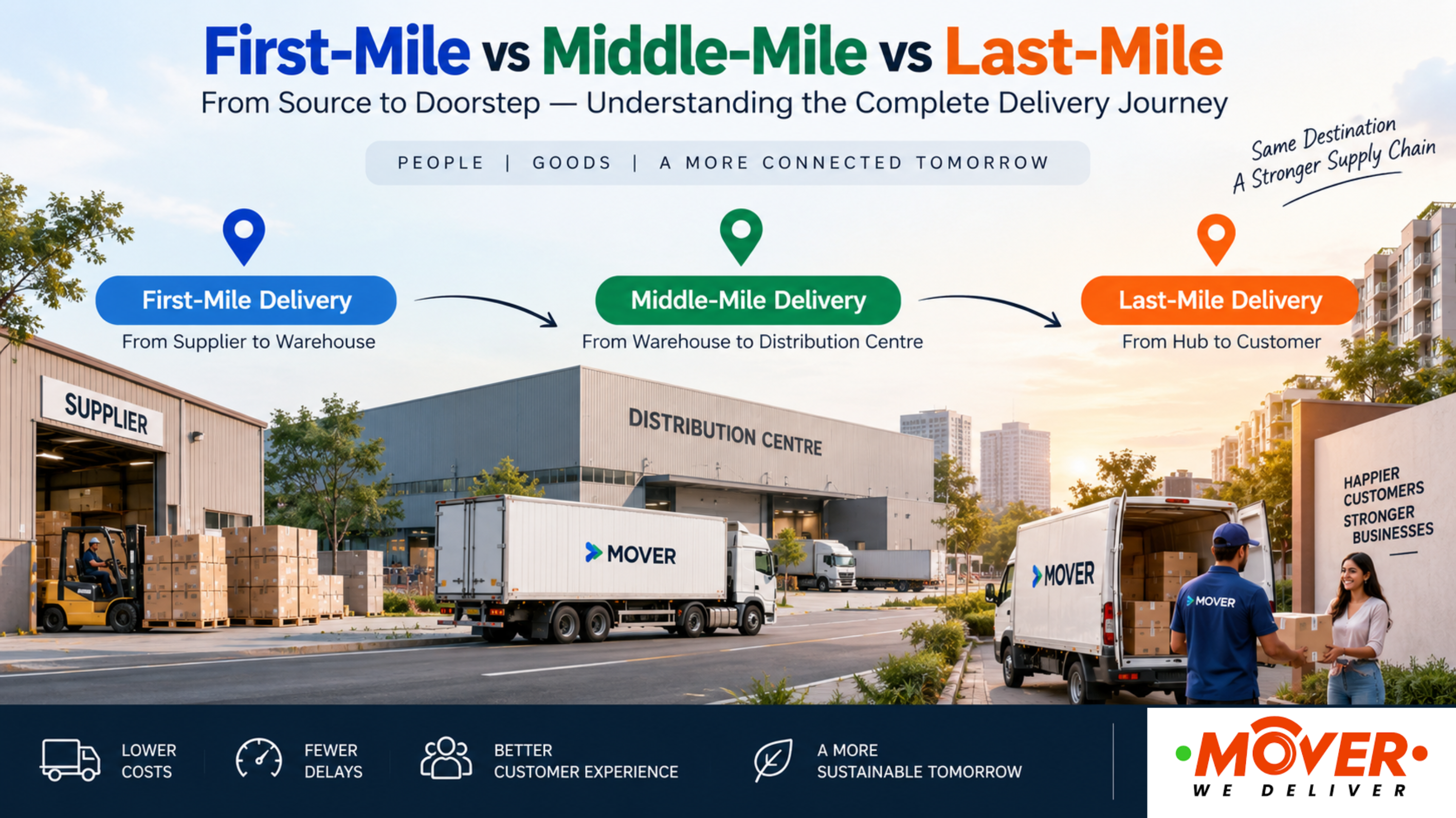
First-mile delivery involves collecting goods from manufacturers or suppliers and moving them to a warehouse or distribution centre. Middle-mile delivery transfers shipments between warehouses, hubs, and regional distribution facilities. Last-mile delivery completes the journey by transporting goods from a local hub to the customer or final delivery point.
Each stage has its own transportation requirements, cost drivers, and operational challenges. For example, the last few kilometres can account for around 53% of total shipping costs, meaning they may cost more than the rest of the journey combined.
This guide breaks down first-mile, middle-mile, and last-mile delivery using practical examples and real cost data. You’ll learn how each stage works, where expenses and delays arise, and how businesses can improve their overall delivery logistics.
What Is First-Mile Delivery?
First-mile delivery is the initial stage of the logistics process, where goods are collected from a manufacturer, supplier, producer, or seller and transported to a warehouse, distribution centre, or fulfilment facility. It marks the beginning of a shipment’s journey through the supply chain.
Although it is called the “first mile,” this stage does not always involve a short distance. Depending on the business model, goods may travel several kilometres before reaching the next logistics point. The main purpose is to move products from their source into the wider distribution network so they can be stored, processed, and sent to the next destination.
Key Activities in First-Mile Delivery
First-mile operations generally involve:
-
Product collection: Picking up goods from manufacturers, suppliers, or sellers.
-
Packaging: Preparing products for safe transportation and handling.
-
Labelling: Adding shipment details, barcodes, and tracking information.
-
Initial tracking: Recording the shipment and monitoring its movement.
-
Warehouse handover: Delivering the goods to a warehouse or distribution centre for further processing.
Common Challenges in First-Mile Delivery
Businesses may face several difficulties at this stage:
-
Pickup coordination: Aligning collection times with suppliers, drivers, and warehouse schedules.
-
Packaging errors: Incorrect packaging or labelling can cause damage, delays, or tracking issues.
-
Inventory inaccuracies: Differences between recorded and actual stock can disrupt shipment preparation.
-
Upstream delays: Production delays, unavailable goods, or late pickups can affect the entire delivery timeline.
-
Vehicle selection: Choosing an unsuitable vehicle can increase transportation costs, especially for short warehouse-to-hub movements.
For example, a business transporting goods from a supplier to a nearby warehouse may need a vehicle that is compact, economical, and suitable for frequent trips. Choosing the right vehicle based on fuel type, load capacity, and route requirements can help improve first-mile efficiency.
What Is Middle-Mile Delivery?
Middle-mile delivery is the second stage of the logistics process. It involves transporting goods between warehouses, distribution centres, fulfilment hubs, and regional facilities. Once products reach a warehouse during the first-mile stage, middle-mile transportation moves them closer to the locations where they will eventually be sorted and delivered.
For example, goods may travel from a central warehouse to a regional distribution centre or from a major logistics hub to a local fulfilment facility. Unlike first-mile delivery, which focuses on collecting products, middle-mile delivery focuses on moving larger shipments efficiently across the distribution network.
Key Activities in Middle-Mile Delivery
Middle-mile logistics commonly includes:
-
Long-distance transportation: Moving goods between cities, states, or regions.
-
Bulk shipment movement: Transporting large quantities of products in one trip.
-
Load consolidation: Combining shipments to improve vehicle capacity.
-
Deconsolidation: Separating bulk shipments at a warehouse or regional hub.
-
Hub-to-hub transfers: Moving inventory between major logistics facilities.
-
Route planning: Selecting efficient routes based on distance, traffic, fuel use, and delivery schedules.
Main Cost Drivers
Middle-mile expenses are often influenced by:
-
Fuel consumption
-
Vehicle maintenance
-
Driver and transportation costs
-
Distance covered
-
Shipment volume and vehicle utilisation
-
Tolls and regulatory charges
While labour can account for around 50 - 60% of the last-mile cost structure, middle-mile expenses are often more closely linked to fuel usage, long-distance routes, vehicle capacity, and shipment consolidation.
Common Challenges in Middle-Mile Delivery
Businesses may encounter challenges such as:
-
Poor load optimisation: Underutilised vehicles increase the cost per shipment.
-
Long-distance delays: Traffic, weather, road conditions, and breakdowns can affect schedules.
-
Regulatory restrictions: Different regions may have varying transport rules and permit requirements.
-
Cross-border complications: Customs procedures and documentation can delay movement.
-
Emission restrictions: Cities and states may introduce policies that affect vehicle choice and route planning.
For instance, businesses moving goods through urban areas may need to consider electric commercial vehicles to meet changing emission requirements. Understanding policies such as the Delhi EV Policy can help logistics operators plan more sustainable and compliant transportation networks.
What Is Last-Mile Delivery?
Last-mile delivery is the final stage of the logistics process, where goods move from a local warehouse, fulfilment centre, or delivery hub to the customer’s doorstep or another final destination. It is the stage most visible to customers because it directly affects when and how they receive their orders.
Although it is called the “last mile,” the actual distance may be much longer or shorter depending on the location, delivery network, and route. The main objective is to complete each delivery accurately, quickly, and cost-effectively.
Key Activities in Last-Mile Delivery
Last-mile operations usually involve:
-
Order sorting: Organising shipments by delivery area and route.
-
Vehicle loading: Loading products into delivery vehicles in the correct sequence.
-
Route planning: Selecting efficient routes based on distance, traffic, and delivery schedules.
-
Customer communication: Sharing delivery updates and estimated arrival times.
-
Final drop-off: Delivering the shipment to the customer or designated location.
-
Proof of delivery: Recording confirmation through a signature, OTP, photograph, or digital update.
-
Returns handling: Collecting products when customers reject, return, or exchange an order.
Why Is Last-Mile Delivery So Expensive?
The last-mile stage can account for approximately 53% of total shipping costs, meaning the final few kilometres may cost more than the rest of the delivery journey combined. Several factors contribute to this high cost:
-
Multiple individual deliveries instead of one bulk shipment
-
Fuel and vehicle maintenance expenses
-
Driver wages and delivery time
-
Traffic congestion and parking difficulties
-
Failed deliveries and repeated attempts
-
Customer-specific delivery instructions
-
Cash-on-delivery handling and return shipments
In India, return-to-origin (RTO) rates can average around 23%, while cash on delivery remains particularly common in Tier 2 and Tier 3 cities. Failed deliveries, incorrect addresses, and customer unavailability can therefore increase the cost of completing an order.
Common Challenges in Last-Mile Delivery
Businesses commonly face:
-
Urban congestion: Traffic and limited parking can slow down delivery routes.
-
Address ambiguity: Incomplete or unclear addresses make it difficult to locate customers.
-
High customer expectations: Customers increasingly expect fast, flexible, and trackable deliveries.
-
COD dependency: Cash collection can increase handling complexity and failed-delivery risks.
-
Failed deliveries: Customer unavailability or incorrect details may require repeated attempts.
-
Returns and exchanges: Reverse logistics can add extra transportation and processing costs.
For example, a delivery executive may have to visit several different locations within a small area while dealing with traffic, parking restrictions, and changing customer instructions. Better route planning, accurate address details, timely customer communication, and suitable delivery vehicles can help businesses make last-mile operations more efficient.
First-Mile vs Middle-Mile vs Last-Mile Delivery: Key Differences
Although first-mile, middle-mile, and last-mile delivery are connected, each stage serves a different purpose within the supply chain. They vary in terms of transportation routes, shipment volumes, cost drivers, and operational challenges.
|
Delivery Stage |
Typical Route |
Main Cost Drivers |
Biggest Challenges |
Primary Focus |
|
First-mile delivery |
Supplier or manufacturer → Warehouse or distribution centre |
Pickup coordination, packaging, vehicle selection, and initial handling |
Supplier delays, inaccurate shipment details, and packaging issues |
Moving goods into the logistics network |
|
Middle-mile delivery |
Warehouse or hub → Regional distribution centre or fulfilment facility |
Fuel, distance, vehicle utilisation, tolls, and long-distance transportation |
Poor load planning, traffic, regulations, and route delays |
Moving goods between logistics facilities |
|
Last-mile delivery |
Local hub → Customer or final destination |
Driver time, fuel, individual drop-offs, failed deliveries, and returns |
Congestion, unclear addresses, customer availability, and delivery expectations |
Completing the final delivery |
Understanding the Difference
The main difference lies in where the goods are moving and what the stage is designed to achieve:
-
First-mile delivery begins the shipment journey by collecting products from their source.
-
Middle-mile delivery connects warehouses, hubs, and distribution centres.
-
Last-mile delivery completes the journey by delivering products to the final destination.
Together, these three stages form the core of the delivery logistics process. A delay in one stage can affect the stages that follow, making coordination across the entire supply chain essential.
Why Do These Delivery Stages Matter for Your Business?
Understanding first-mile, middle-mile, and last-mile delivery helps businesses identify where transportation costs, delays, and inefficiencies enter the supply chain. Even when each stage operates separately, a problem in one part can affect the entire delivery process.
For example, a delay in collecting goods from a supplier can disrupt warehouse operations. Poor coordination between distribution centres can slow down inventory movement, while inefficient final delivery routes can increase fuel usage, driver time, and customer waiting periods.
The importance of these stages is growing as e-commerce, quick commerce, and direct-to-consumer businesses expand. The global last-mile delivery market is projected to grow from approximately $186 billion in 2025 to $487 billion by 2035, showing how much investment and operational pressure the delivery sector is experiencing.
However, growth does not automatically mean lower costs. Businesses must improve each stage of the logistics network to manage expenses, maintain delivery speed, and meet customer expectations.
Key Business Benefits of Understanding Delivery Stages
-
Better cost control: Identify which stage is creating unnecessary expenses.
-
Improved delivery planning: Select suitable vehicles, routes, and transportation methods.
-
Fewer delays: Coordinate suppliers, warehouses, hubs, and delivery teams more effectively.
-
Higher vehicle utilisation: Improve load planning and reduce empty or underused trips.
-
Better customer experience: Support accurate, timely, and reliable deliveries.
-
More sustainable operations: Consider electric vehicles, route optimisation, and reduced fuel consumption.
By evaluating all three stages together, businesses can build a more efficient delivery network instead of optimising only one part of the journey.
How to Optimise First-Mile, Middle-Mile, and Last-Mile Delivery
Improving delivery efficiency requires businesses to examine all three logistics stages instead of focusing on only the final delivery. Small improvements in planning, coordination, and transportation can help reduce costs and prevent delays across the supply chain.
1. How to Optimise First-Mile Delivery
-
Coordinate pickup schedules with suppliers in advance.
-
Use accurate packaging, labelling, and inventory records.
-
Select vehicles based on shipment size, route, and fuel efficiency.
-
Consolidate pickups whenever possible to reduce unnecessary trips.
-
Track shipments from the moment goods leave the supplier.
2. Optimise Middle-Mile Delivery
-
Consolidate shipments to improve vehicle utilisation.
-
Plan routes according to distance, traffic, tolls, and delivery deadlines.
-
Avoid underloaded vehicles and unnecessary return journeys.
-
Use technology to monitor vehicle movement and shipment progress.
-
Consider electric or fuel-efficient vehicles where routes and regulations allow.
3. Optimise Last-Mile Delivery
-
Use route-planning tools to reduce travel time and fuel consumption.
-
Verify customer addresses and contact details before dispatch.
-
Send delivery notifications to reduce customer unavailability.
-
Group deliveries within the same neighbourhood or locality.
-
Track failed deliveries and identify the reasons behind them.
-
Offer suitable delivery time slots where operationally possible.
By improving each stage together, businesses can reduce avoidable transportation expenses, improve delivery reliability, and create a more coordinated logistics network.
Conclusion
First-mile, middle-mile, and last-mile delivery each play an important role in moving goods through the supply chain. From collecting products from suppliers to transferring shipments between logistics facilities and completing the final delivery, every stage influences transportation costs, delivery speed, and customer satisfaction.
Businesses can improve overall logistics performance by coordinating pickups, optimising vehicle loads, planning efficient routes, and reducing failed deliveries. Using the right transportation solutions at each stage can also help control expenses and improve operational efficiency.
If you’re looking for a convenient way to manage transportation requirements, online truck booking can help simplify the process of finding and booking suitable vehicles. Businesses and individuals can also explore the online truck booking app to manage truck bookings more conveniently.
By improving coordination across all three delivery stages, businesses can build a more reliable, cost-effective, and scalable logistics network.
Frequently Asked Questions
1. What is the difference between first-mile, middle-mile, and last-mile delivery?
First-mile delivery moves goods from a supplier or manufacturer to a warehouse. Middle-mile delivery transfers shipments between warehouses, hubs, and distribution centres. Last-mile delivery takes goods from a local hub to the customer or final destination.
2. Which delivery stage is the most expensive?
Last-mile delivery is generally the most expensive because it involves individual drop-offs, route complexity, driver time, traffic, failed deliveries, and customer-specific requirements.
3. Why is first-mile delivery important?
First-mile delivery begins the movement of goods through the supply chain. Delays in pickup, packaging, labelling, or supplier coordination can affect warehouse operations and the delivery stages that follow.
4. What happens during middle-mile delivery?
Middle-mile delivery involves transporting goods between logistics facilities. It may include long-distance trucking, shipment consolidation, warehouse transfers, and movement between central and regional distribution centres.
5. How can businesses reduce last-mile delivery costs?
Businesses can reduce last-mile costs by optimising delivery routes, grouping nearby orders, verifying customer addresses, reducing failed deliveries, improving customer communication, and choosing suitable vehicles.
6. Are these delivery stages used in every supply chain?
Most organised supply chains involve activities similar to these three stages. However, not every shipment follows the same route. Some goods may move directly from a supplier to a customer, while others may pass through several warehouses and distribution hubs.