
Summary
Appointment-based delivery helps you plan B2B shipments around a fixed date and time slot instead of a broad delivery window. For businesses supplying quick-commerce platforms, the process involves checking the PO, preparing the shipment and documents, booking the slot, arranging the right vehicle, and making sure the delivery reaches the receiving location on time. Missing an appointment can delay stock, lead to rescheduling or rejection, increase transportation and waiting costs, and affect inventory availability. As you manage more warehouses and shipments, keeping appointments, vehicles, documents, and delivery status organised becomes even more important. A reliable transportation setup with suitable vehicle capacity, route planning, and shipment visibility can help you handle scheduled B2B deliveries more smoothly.
Introduction
Have you ever faced such an issue as an entrepreneur that you’ve done everything from packing orders, arranging vehicles, to sending them to the warehouse? But at the last moment, you get to know that the delivery slot has already passed. For businesses supplying quick-commerce platforms, that can create a bigger problem than a few hours of waiting.
This is where appointment-based delivery becomes important. Instead of delivering whenever the vehicle reaches the destination, you work against a pre-booked date and time slot. The shipment, vehicle, documents, and warehouse receiving process all need to line up.
For brands supplying platforms such as Blinkit, Zepto, and Instamart, this process can affect how smoothly inventory reaches the network. A missed appointment may mean rejection, rescheduling, delayed stock availability, or issues with delivery-performance metrics.
In this article, we’ll look at how appointment-based delivery works, how the major quick-commerce platforms handle inbound deliveries, what happens when you miss a slot, and how you can manage B2B scheduled deliveries at scale.
What Is Appointment-Based Delivery?
If your shipment is ready to ship, you may have a delivery date or a broad time window, and the vehicle can reach the destination within that period; that is regular delivery. Whereas, in appointment-based delivery, you work with a much tighter schedule. You will get a particular date and time slot. Within that time slot window, the order has to reach the warehouse.
That means as a business owner, you need to plan everything. You need to coordinate the purchase order, shipment, documents, vehicle, transit time, and receiving slot so everything lines up.
|
Factor |
Standard Delivery |
Appointment-Based Delivery |
|
Delivery timing |
Broad or flexible window |
Pre-confirmed date and time slot |
|
Coordination |
Relatively simple |
Requires coordination before dispatch |
|
Receiving location |
General delivery point |
Specific warehouse or fulfilment location |
|
Waiting time |
Can be unpredictable |
Planned around the appointment |
|
Missed window |
Usually causes a delay |
May lead to rejection or rescheduling |
|
Common use |
Regular shipments |
B2B inventory and scheduled replenishment |
For example, if you're supplying inventory to a quick-commerce warehouse, you can't just dispatch the vehicle and hope it arrives during business hours. The receiving team may follow a specific appointment schedule, so arriving at the wrong time can disrupt the entire delivery.
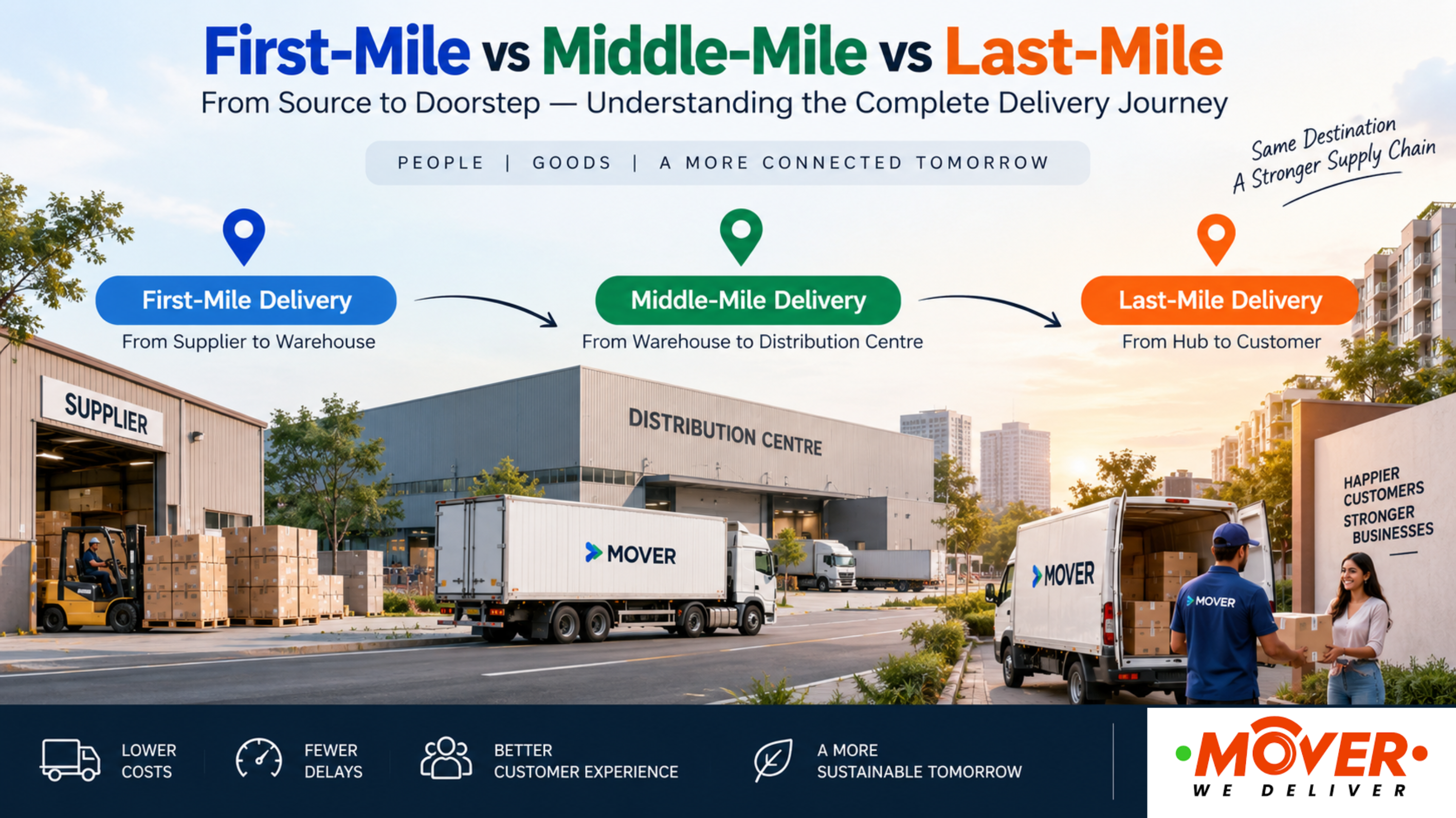
This is also where first-mile and middle-mile delivery come into the picture. The goods still need to move from your warehouse or supplier to the receiving facility, but with ABD, that movement has to be planned around a confirmed receiving slot.
So, appointment-based delivery isn't simply about delivering on a particular day. It is about making sure the shipment, vehicle, documents, and receiving team are all ready at the same time.
Why Do Quick-Commerce Platforms Require Appointment Delivery?
In a quick-commerce warehouse, there are multiple things going on, including receiving inventory of products as well as delivering the parcels to the customers. Due to this, the workers are occupied most of the time, which makes it very easy to plan everything if they know the delivery timing and inventory quantity.
This is the reason why appointment-based deliveries are important for quick-commerce platforms such as Blinkit, Zepto, and Instamart. An appointment delivery service works around a confirmed receiving slot, helping you coordinate the shipment with the destination's schedule.
How Does Fill Rate Affect Quick-Commerce Deliveries?
Suppose a platform places a PO for 1,000 units, but your shipment arrives with only 700 units. The delivery may have reached the warehouse, but the platform still hasn't received the inventory it expected.
That's where fill rate comes in. It looks at how much of the ordered quantity you actually supply.
Some report 90%+ fill-rate expectations for Blinkit, which are commonly referred to by seller and industry sources. Whereas Blinkit publishes no official claim, some of the third-party sources believe that performance below certain thresholds can affect seller visibility or ranking. So they should be treated as seller-reported information rather than a confirmed platform rule.
For a brand, the takeaway is simpler: arriving on time isn't enough if the shipment doesn't contain the expected quantity.
And before a brand even reaches that stage, understanding the process of registering as a Blinkit seller can help clarify how inventory and seller operations are structured.
What Does OTIF Mean for B2B Appointment Delivery?
Quick-commerce replenishment also makes OTIF (On-Time In-Full) important.
The name itself explains what it measures:
-
On Time: Did the shipment arrive within the required delivery window?
-
In Full: Did the shipment contain the complete quantity expected?
So, a shipment that arrives two hours late isn't OTIF. Neither is a shipment that arrives on time but is missing a significant part of the PO.
This matters because quick-commerce depends on keeping products available when customers search for them. A delay or incomplete replenishment can leave less stock available at the receiving end.
For businesses working with Instamart, understanding Instamart seller onboarding also helps because the selling process runs alongside these inventory and fulfilment requirements.
How Does Stock Availability Affect Quick-Commerce Products?
The real reason behind all this is product availability. If a customer orders a product from a particular platform, then it needs to be fulfilled. If not, then it not only impacts the image of the platform negatively but also affects the visibility of the product on the quick-commerce platforms.
For example, Braincuber reports a relationship between repeated stockouts and reduced visibility. This is not an officially published ranking rule from the platforms, so it should be treated as an industry-reported claim rather than a guaranteed outcome.
For a brand, though, the operational issue is very real: if your inventory doesn't reach the required location on time and in the required quantity, customers may not be able to order it.
That is why appointment delivery is more than a warehouse scheduling exercise. It helps quick-commerce platforms coordinate when inventory arrives, how much arrives, and when that stock can become available for customers.
The same principle applies when a brand is supplying inventory to Zepto: predictable replenishment becomes part of keeping the supply chain moving smoothly.
Why This Matters for You as a Brand
Think of ABD as a chain:
PO → Appointment Slot → Vehicle Arrival → Inwarding → Stock Availability → Customer Orders
A problem at the delivery stage can therefore affect what happens much later in the chain.
You may have demand, inventory ready at your warehouse, and customers waiting to buy, but if the shipment misses its receiving window, that stock may not reach the platform when it is needed.
That is the real reason appointment-based delivery matters in quick commerce: it keeps inventory movement predictable enough for the platform to keep products available.
How Appointment-Based Delivery Works: Step by Step
Now that you have understood what appointment-based delivery is and why it is important, it’s time to know the process. It may look like a simple slot-booking exercise, but there are many steps you need to follow before the shipment reaches the receiving location.
The basic process looks like this:
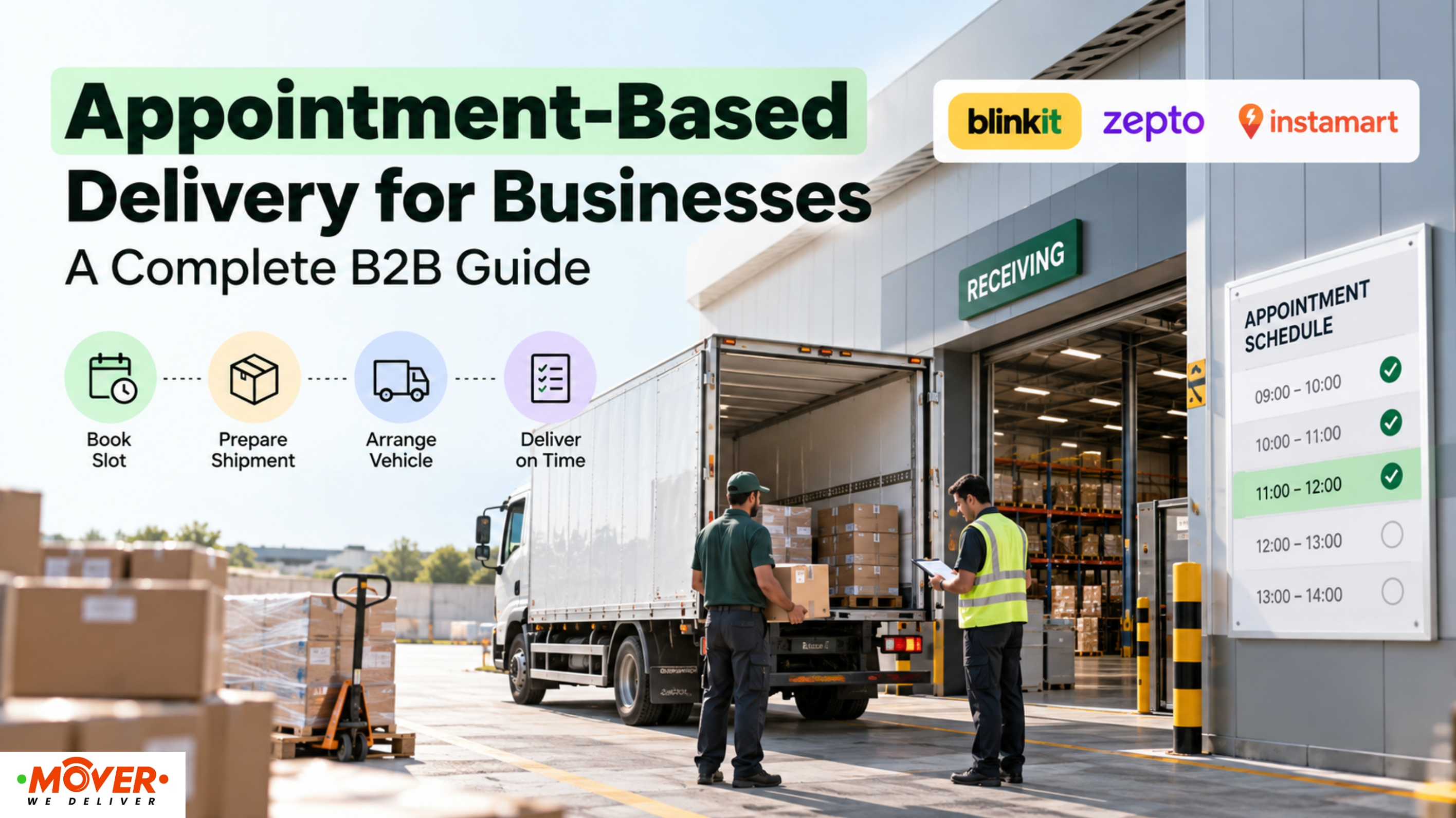
PO received → Shipment prepared → Slot booked → Documents ready → Vehicle dispatched → Gate entry & receiving → POD/GRN
Here’s what each step involves.
Step 1: You Receive the Purchase Order
The very first step is to raise a purchase order, also known as a PO, for the inventory by the buyer or platform. You need to check the PO carefully before planning the shipment. Look at the products, quantities, destination, and required delivery timeline so you know exactly what needs to be moved.
Step 2: You Prepare the Shipment
Once the purchase order is created, you need to accept it and can start preparing your order.
This includes picking the required quantity, packing the products as instructed, and checking labels, barcodes, or other product requirements before dispatch.
A simple quantity or packing mistake here can create problems when the shipment reaches the warehouse.
Step 3: You Book the Delivery Slot
This is the step that makes appointment-based delivery different from a regular shipment.
Instead of sending the vehicle and hoping the warehouse can receive it, you first select the delivery date and time slot available for the relevant receiving location.
Your vehicle plan should then be built around that appointment. You don't want to book a 2 PM slot and start thinking about the transport at 1:30 PM.
Step 4: You Get the Documents Ready
Before the vehicle leaves, make sure the paperwork matches the shipment and PO.
Depending on the platform and shipment, this may include:
-
Purchase order
-
Tax invoice
-
E-way bill, where applicable
-
Advance Shipping Notice (ASN)
-
PO or shipment number
-
Required labels and barcodes
The exact documents can vary, so always check the requirements for the specific platform and destination.
Step 5: You Dispatch the Vehicle
Once the shipment and paperwork are ready, you can dispatch the vehicle.
This is where transit planning becomes important. Your vehicle doesn't just need to reach the destination on the same day; it needs to reach within the booked appointment window.
Traffic, loading delays, route conditions, and congestion near the receiving location can all affect the arrival time. Building in some buffer can help you avoid a last-minute rush.
Step 6: The Vehicle Reaches the Gate
When the vehicle arrives, the receiving team may first verify the appointment and shipment details before allowing entry.
After gate entry, the shipment can go through receiving checks such as:
-
Quantity verification
-
Barcode or EAN checks
-
Packaging checks
-
PO and invoice matching
-
Inwarding
This is also where a missed appointment can become a problem. Some platform-specific seller sources report that vehicles arriving outside their allotted slot may be refused at the gate, but the exact process can vary by platform and location.
Step 7: The Delivery Is Closed
Once the shipment is accepted and received, the final step is confirming that the delivery has been completed. This may happen through a Proof of Delivery (POD), Goods Receipt Note (GRN), or the platform's equivalent confirmation. At this point, the shipment has completed the appointment-based delivery cycle.
The Simple Way to Look at ABD
You can think of the whole process as one connected chain:
Right PO → Right quantity → Right slot → Right documents → Right vehicle → Right arrival time → Successful receiving
A delay at any one of these stages can affect the next. That's why scheduled delivery for businesses requires more coordination than simply booking a vehicle and sending it to the destination.
What Happens When You Miss an Appointment Slot?
Getting your shipment ready and booking the slot is only part of the job. You also need your vehicle to reach the receiving location within that window.
So, what happens when you miss it?
The first problem is usually simple: your stock doesn't get received when you planned it to. Depending on the platform and warehouse, the shipment may need to be rescheduled or can even be refused at the gate. That pushes the entire restoration stock cycle further down the line.
Your Inventory Gets Delayed
Suppose you planned to deliver 500 units on Monday morning. If the truck misses the appointment and the shipment has to be rescheduled, those 500 units may not be available at the receiving location until the next slot.
For a fast-moving product, even a short delay can matter. You could end up with less stock available while customer demand is still coming in.
You May Face Additional Transportation Costs
A missed slot doesn't necessarily end with a new appointment.
You may also have to deal with:
-
Another trip to the warehouse
-
Extra vehicle or driver costs
-
Longer waiting and unloading times
-
Detention or dwell-time charges
-
Additional coordination with the receiving team
The exact cost depends on the carrier, warehouse and reason for the delay, so there isn't one fixed penalty that applies to every ABD shipment.
How Can Missed Slots Increase Scheduled Delivery Costs?
There is another issue that is easy to overlook: truck waiting time.
Research from the American Transportation Research Institute, cited by Opendock, found that drivers were detained for more than two hours at 39.3% of stops in 2023, with scheduling issues on the receiving side identified as one contributor.
That doesn't mean every appointment-based delivery will involve detention. It does show how quickly waiting at receiving facilities can become a wider logistics cost when schedules aren't coordinated properly.
A well-managed dock appointment system can help reduce this uncertainty. Tacto reports that slot booking can reduce waiting times by up to 70%, although that figure comes from its own industry guidance and should not be treated as a guaranteed reduction for every warehouse.
Can Missed Slots Affect Your Quick-Commerce Performance?
There is one more thing you need to consider when supplying quick-commerce platforms: delivery performance is connected to stock availability.
A late shipment can mean your expected inventory reaches the warehouse later than planned. An incomplete shipment can create a similar problem even when the vehicle arrives on time.
Third-party seller and industry sources have also reported possible effects on metrics such as fill rate, OTIF, stock availability, and product visibility when fulfilment performance consistently falls short. The exact thresholds and consequences are platform-specific and are not all publicly documented, so you should treat those claims cautiously.
The practical takeaway is easier to understand:
One missed appointment can delay one shipment. Repeated misses can start affecting how reliably you keep inventory available.
And when a shipment is eventually rejected or has to come back, you can also end up dealing with rejected or returned stock, adding another layer of transportation and handling to the process.
So, the cost of missing an appointment isn't just the time lost at the gate. You can also lose delivery capacity, incur additional transport costs, delay replenishment, and create knock-on problems for inventory availability.
Blinkit vs Zepto vs Instamart: How B2B Delivery Requirements Differ
Once you start supplying inventory to quick-commerce platforms, you’ll notice that the basic idea stays the same, but the actual process can differ from one platform to another.
You may deal with a PO, prepare the stock, arrange documents, and send a vehicle to the receiving location. But the appointment workflow, warehouse structure, and receiving requirements are not necessarily identical.
So, before you plan your Blinkit business delivery, Zepto business delivery, or Instamart business delivery, it helps to know where the processes differ.
|
Factor |
Blinkit |
Zepto |
Instamart |
|
PO-based supply |
Yes |
Yes |
Reported |
|
Delivery scheduling |
Appointment date and time selected through seller workflow |
Advance delivery scheduling is supported |
Appointment/booking process is reported |
|
Receiving location |
Warehouse linked to the relevant network |
Central warehouse model is reported |
Public information varies |
|
Slot process |
Seller-side appointment process reported |
Exact slot-booking mechanics not clearly verified |
Public details are limited |
|
Missed slot |
Refusal/rescheduling is reported by seller-side sources |
Exact process not clearly verified |
Exact process not clearly verified |
|
Performance metrics |
Fill rate, OTIF and PO-related metrics |
Fill-rate and availability-related metrics |
OTIF and availability-related metrics |
|
Documents |
PO, invoice and other shipment documents |
PO and shipment-related documents |
PO, invoice and product-related documents |
Why Multi-Warehouse Appointment Delivery Gets Hard
Managing one appointment is simple. The real challenge starts when you have multiple POs going to different warehouses, each with its own delivery slot.
You now need to coordinate the:
-
Appointment time
-
PO and documents
-
Vehicle and route
-
Travel and unloading time
-
Delivery status
A delay at one location can also affect the next delivery, especially when the same vehicle is handling multiple drops.
As your delivery network grows, manually tracking all these moving parts can become difficult. This is where coordinating multiple delivery partners and having better shipment visibility can make scheduled B2B deliveries easier to manage.
Dedicated Vehicle vs Multi-Carrier Linehaul
When you have a fixed delivery slot, the vehicle you choose also matters.
|
Factor |
Dedicated Vehicle |
Multi-Carrier Linehaul |
|
Timing control |
Higher |
Depends on the carrier |
|
Best for |
Planned shipments |
Variable shipments |
|
Route control |
Easier |
Shared across carriers |
|
Vehicle choice |
Mini trucks, pickups, larger vehicles |
Depends on carrier network |
|
Coordination |
Simpler |
More coordination |
A dedicated mini truck can work well when you have a planned shipment that needs to reach a warehouse within a fixed appointment window. It gives you more control over the route, loading, and arrival time.
A multi-carrier setup can be useful when you have shipments going to different locations or your volumes keep changing, but you'll need to coordinate multiple vehicles and carriers.
When comparing delivery partners for scheduled dispatch, look at more than vehicle availability. Timing, tracking, vehicle capacity, and route coverage can all affect whether your shipment reaches the appointment on time.
Beyond Quick Commerce: Where Else Can Appointment Delivery Work?
Appointment-based delivery can also be useful when you’re supplying retail chains, marketplaces, manufacturers, or other B2B buyers that work with fixed receiving schedules.
It helps you coordinate the shipment around when the receiving location is ready to accept it, rather than simply sending the vehicle and waiting.
How Can You Stay Compliant With Appointment Delivery Requirements?
Missing a slot is often easier to avoid when you plan the shipment around the appointment, not after it.
Here are a few things you can do:
-
Track every appointment: Keep the PO, warehouse, slot, vehicle, and delivery status together.
-
Keep documents ready: Check invoices, PO details, labels, and other required paperwork before dispatch.
-
Add a time buffer: Allow extra time for traffic, loading, and unloading delays, especially in busy urban areas. This gives you buffer time for traffic and congestion.
-
Choose the right vehicle: Make sure the vehicle has enough capacity for the shipment and can handle the planned route.
-
Confirm before dispatch: Recheck the appointment slot and receiving instructions before the vehicle leaves.
-
Keep delivery visibility: A scheduled delivery service with live tracking and clear booking records can help you check whether the vehicle is still on schedule.
Make Appointment-Based Delivery Easier with MOVER
Managing appointment-based delivery means more than booking a vehicle. You also need to make sure the shipment reaches the right location on time and that you can keep track of it along the way.
MOVER helps businesses arrange scheduled transportation, multiple vehicle types, and multi-location deliveries, along with real-time tracking and proof of delivery.
Whether you're moving regular B2B shipments or handling replenishment across multiple locations, you can choose a vehicle based on your load, route, and delivery requirements.
Plan your next scheduled delivery with MOVER and keep your business shipments moving on schedule.
Conclusion
Appointment-based delivery gives you more control over when and where your B2B shipment is received. But getting the slot is only one part of the process. You still need the right stock, documents, vehicle, route, and timing to make the delivery successful.
For businesses supplying Blinkit, Zepto, Instamart, or other B2B buyers, a missed appointment can delay replenishment, create extra transportation costs, and affect stock availability. As your number of warehouses and shipments grows, keeping all these moving parts coordinated becomes even more important.
For planned B2B movements, online truck booking can help you arrange the right vehicle according to your shipment and route. An online truck booking app can also give you better visibility into vehicle availability, tracking, and delivery status.
With the right planning and transportation setup, you can make scheduled delivery for businesses more predictable and avoid unnecessary delays, waiting time, and repeat trips.
FAQs
1. Who books an appointment-based delivery slot?
It depends on the platform and its seller workflow. In some cases, you may book the slot while creating the shipment, while other platforms may provide the appointment details through their PO or vendor portal.
2. What happens if your vehicle arrives after the appointment time?
The shipment may need to be rescheduled, and some receiving locations may refuse the vehicle at the gate. The exact process depends on the platform and warehouse.
3. Can one vehicle handle multiple appointment-based deliveries?
Yes, provided the route and delivery slots are planned carefully. You need enough time between appointments for travel, loading, unloading, and unexpected delays.
4. What documents do you need for B2B appointment delivery?
Depending on the shipment, you may need documents such as the PO, tax invoice, e-way bill, ASN, and shipment or product labels. Requirements can vary by platform and destination.
5. How can you manage appointments across multiple warehouses?
Keep your POs, appointment slots, vehicles, documents, and delivery status organised in one system. This makes it easier to spot schedule conflicts and act before a shipment is delayed.
6. Can a logistics partner help with scheduled B2B deliveries?
Yes. A logistics partner can help with the transportation side by arranging suitable vehicles, planning routes, and providing shipment visibility. However, the business still needs to follow the receiving platform's appointment and documentation requirements.