

Summary
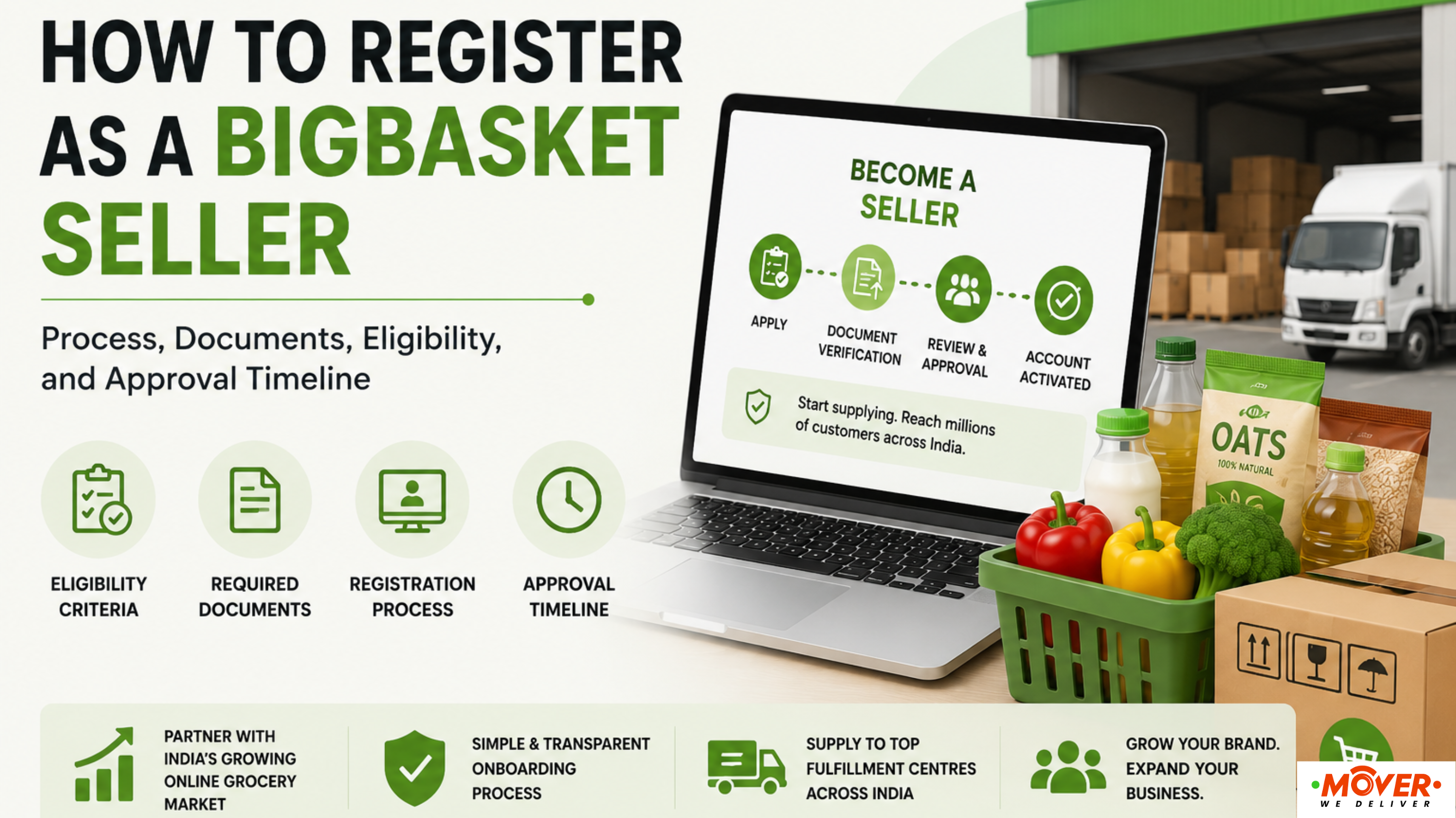
Registering as a BigBasket seller involves applying through the BB Sambandh vendor portal or the BigBasket Partner Portal, submitting your business information and product catalogue, and completing the vendor verification process. After reviewing your application, BigBasket evaluates your product quality, pricing, inventory capability, and category fit before approving new suppliers. This guide explains how to register as a BigBasket seller, covering the BigBasket seller registration process, eligibility criteria, BigBasket seller documents required, onboarding timeline, and practical tips to improve your chances of approval. It also explains how to efficiently supply inventory to BigBasket's fulfilment centres once your products go live.
Introduction
Getting your products onto supermarket shelves takes time, but getting them listed on a leading online grocery platform can help you reach customers across multiple cities without expanding your physical retail network. BigBasket has become one of India's most trusted online grocery platforms, making it an attractive sales channel for FMCG brands, D2C businesses, manufacturers, and wholesalers looking to grow their customer base.
However, becoming a supplier isn't as simple as submitting a registration form. Businesses must meet BigBasket's eligibility requirements, prepare the necessary documents, complete the vendor verification process, and demonstrate their ability to maintain a reliable supply chain before their products are approved.
Understanding the BigBasket seller registration process before applying can help you avoid common mistakes and prepare your business for a smoother onboarding experience. From business registration and product catalogues to category reviews, commercial discussions, and compliance verification, every stage plays an important role in determining whether your application is approved.
This guide explains how to register as a BigBasket seller, covering the eligibility criteria, BigBasket seller documents required, the step-by-step vendor onboarding process, approval timeline, common reasons applications are rejected, and practical tips to improve your chances of success. You'll also learn how to efficiently transport inventory to BigBasket's fulfilment centres once your products are approved, helping your business prepare for long-term growth on the platform.
Why BigBasket?
-
50,000+ Products listed
-
30+ Major Cities
-
700+ Dark Stores Across India
-
1,000+ Brands
Why Sell on BigBasket?
BigBasket has evolved from an online grocery platform into a comprehensive retail ecosystem, offering everything from fresh fruits and vegetables to packaged foods, beverages, personal care products, home essentials, and gourmet items. With a presence across multiple Indian cities and a large base of repeat customers, it provides brands with an opportunity to build long-term sales rather than relying solely on traditional retail channels.
For businesses planning to sell on BigBasket, the platform offers several advantages:
-
Access a large and loyal customer base that regularly shops for groceries and daily essentials.
-
Increase repeat purchases for FMCG products, packaged foods, beverages, personal care, and household items.
-
Expand your omnichannel strategy by selling alongside your own website, supermarkets, and other e-commerce marketplaces.
-
Build trust and brand visibility by partnering with one of India's most established online grocery retailers.
-
Reach customers across multiple cities without investing in your own large-scale retail network.
Unlike many marketplace platforms that focus on individual product listings, BigBasket works closely with suppliers to maintain product quality, inventory availability, and a consistent shopping experience. Businesses that can ensure reliable supply, competitive pricing, and compliance with quality standards are better positioned to build long-term partnerships through the BigBasket vendor onboarding process.
Who Can Register as a BigBasket Seller?
BigBasket follows a supplier-based procurement model, partnering with brands, manufacturers, and distributors that can consistently supply quality products to its fulfilment network. Instead of operating as an open marketplace for individual sellers, BigBasket evaluates suppliers based on their product quality, compliance, pricing, and ability to maintain regular inventory.
Businesses that can become a BigBasket supplier include:
-
FMCG brands and manufacturers supplying packaged foods, beverages, personal care products, and household essentials.
-
D2C brands looking to expand their reach through an established online grocery platform.
-
Authorised distributors and wholesalers with valid brand authorisation and reliable supply capabilities.
-
Fresh produce, dairy, bakery, and frozen food suppliers that meet BigBasket's quality and food safety standards.
-
Health, wellness, baby care, pet care, and home care brands offering products with consistent consumer demand.
Before starting the BigBasket seller registration process, ensure your business has a valid GST registration, the required category-specific licences, and the operational capacity to fulfil regular purchase orders. Suppliers with complete documentation and a dependable supply chain are generally better prepared for a smoother onboarding experience.
Eligibility Criteria for BigBasket Seller Registration
Before applying, make sure your business meets BigBasket's basic supplier requirements. While the exact eligibility criteria may vary depending on your product category and sourcing needs, suppliers are generally expected to meet the following requirements.
|
Eligibility Criteria |
Why It Matters |
|
GST Registration |
Required for tax compliance and supplier onboarding. |
|
Registered Business Entity |
Businesses should operate as a proprietorship, partnership, LLP, or company with valid registration documents. |
|
Product Quality |
Products must meet BigBasket's quality standards and customer expectations. |
|
Packaging Standards |
Products should be securely packaged, correctly labelled, and suitable for storage and transportation. |
|
Barcode (EAN/UPC) |
Required for inventory tracking, warehouse management, and catalogue integration. |
|
Reliable Supply Capability |
Suppliers should be able to maintain consistent inventory and fulfil regular purchase orders without stock shortages. |
BigBasket Seller Documents Required
Preparing your documents before applying can help speed up the BigBasket seller registration process. BigBasket verifies your business identity, tax registrations, banking information, and product details before approving new suppliers. Keeping all documents complete and up to date reduces the chances of delays during verification.
Mandatory Documents
|
Document |
Purpose |
|
GST Registration Certificate |
Confirms your business is registered for GST. |
|
PAN Card |
Verifies the business or authorised signatory. |
|
Business Registration Proof |
Proprietorship, Partnership, LLP, or Company Incorporation Certificate. |
|
Bank Account Details & Cancelled Cheque |
Used for supplier payouts and should match the registered business name. |
|
Business Address Proof |
Confirms your registered business address. |
Category-Specific Documents
|
Document |
Applicable For |
|
FSSAI Licence |
Mandatory for food, beverages, fresh produce, dairy, bakery, and other consumable products. |
|
Trademark Certificate (Optional) |
Helps verify brand ownership and may support the onboarding process for brand owners. |
|
Brand Authorisation Letter |
Required for distributors or resellers supplying third-party brands. |
|
Product Catalogue |
Should include SKU details, EAN/barcodes, MRP, dimensions, weight, shelf life (where applicable), and high-quality product images. |
|
Quality or Compliance Certifications |
Required for regulated product categories where applicable. |
Step-by-Step BigBasket Seller Registration Process
Once you've gathered the required documents and confirmed your business meets BigBasket's eligibility criteria, you can begin the BigBasket seller registration process. While the exact onboarding journey may vary depending on your product category and business profile, the following steps outline how most businesses become a BigBasket supplier.
Step 1: Apply Through the BB Sambandh Portal
Visit the official BB Sambandh vendor portal or the BigBasket Partner Portal and submit your supplier application. You'll need to provide your company name, contact details, business information, and the product categories you wish to supply.
Step 2: Share Your Product Catalogue
Once your initial application is submitted, provide your product catalogue for evaluation. Include SKU details, product descriptions, MRP, EAN/barcodes, dimensions, shelf life (where applicable), and high-quality product images. A complete catalogue helps the buying team assess your products more efficiently.
Step 3: Category Team Review
After reviewing your application, BigBasket's category buying team evaluates your product range, pricing, quality standards, sourcing capability, and overall market demand. Depending on your category, they may request additional information or product samples before moving your application to the next stage.
Step 4: Commercial Discussion
If your products meet BigBasket's sourcing requirements, the next step involves finalising commercial terms. This typically includes discussions around trade margins, payment cycles, supply expectations, procurement terms, and the fulfilment locations where your products will be supplied.
Step 5: Complete KYC & Document Verification
Once commercial terms are agreed upon, you'll need to upload the required business documents for verification. These generally include your GST registration certificate, PAN card, business registration proof, bank account details, FSSAI licence (if applicable), and any category-specific compliance documents. BigBasket verifies these documents before activating your supplier account.
Step 6: Supplier Account Activation
After successful verification, your supplier account is activated. At this stage, your approved products are added to BigBasket's procurement system, allowing you to receive purchase orders based on demand and inventory requirements.
Step 7: Supply Inventory to Assigned Fulfilment Centres
Once your account is active, BigBasket shares the designated fulfilment centres or warehouses where your products need to be delivered. Timely inventory replenishment and consistent product availability play an important role in maintaining a successful supplier relationship.
Step 8: Start Selling on BigBasket
After your inventory is received, verified, and stocked, your products become available for customers to purchase through the BigBasket platform. From this point onward, maintaining product quality, competitive pricing, and regular inventory replenishment becomes essential for long-term growth.
How Long Does BigBasket Seller Approval Take?
The BigBasket seller registration process typically takes 1 to 3 weeks, although the exact timeline depends on your product category, document accuracy, commercial discussions, and the category team's evaluation. Suppliers with complete documentation and a well-prepared product catalogue generally experience a smoother onboarding process.
A typical onboarding journey includes the following stages:
|
Onboarding Stage |
Estimated Timeline |
What's Involved |
|
Application & Initial Review |
2–4 days |
BigBasket reviews your supplier application, business profile, and product categories. |
|
Category Team Evaluation |
3–7 days |
The buying team assesses your product range, pricing, quality standards, sourcing capability, and market demand. |
|
Commercial Discussions |
2–5 days |
Trade margins, payment terms, supply expectations, and fulfilment locations are discussed and finalised. |
|
KYC & Document Verification |
2–4 business days |
Verification of GST, PAN, bank details, FSSAI licence (if applicable), and other compliance documents. |
|
Account Activation & Purchase Orders |
2–5 days |
Supplier account activation, onboarding completion, and allocation of the first purchase orders or supply locations. |
Several factors can influence the approval timeline, including the completeness of your documents, the quality of your product catalogue, category-specific demand, and how quickly commercial terms are finalised. Businesses that maintain clear communication with BigBasket's buying team and submit accurate documentation are often able to complete the onboarding process more efficiently.
BigBasket Vendor Onboarding: Commission & Costs
Understanding BigBasket's commercial model is just as important as completing the registration process. Unlike marketplaces that charge a fixed seller registration fee, BigBasket primarily operates on a procurement-based model, where commercial terms are negotiated individually with each supplier during the onboarding process.
The final commercial agreement depends on several factors, including your product category, pricing strategy, sourcing capability, supply volumes, and discussions with BigBasket's buying team. Since every supplier agreement is different, BigBasket does not publicly disclose a standard commission or margin structure.
Besides the agreed commercial terms, suppliers should also account for several operational costs, including:
-
Product packaging and labelling
-
Transportation of inventory to BigBasket fulfilment centres
-
Inventory replenishment and warehousing
-
Category-specific compliance and certification costs
-
Promotional or marketing participation (where applicable)
Keeping transportation and fulfilment costs under control is equally important for maintaining healthy margins. Businesses that regularly supply inventory can benefit from strategies to reduce logistics costs, helping improve operational efficiency as order volumes grow.
*Business Tip: Before agreeing to commercial terms, calculate your product cost, packaging expenses, transportation, inventory carrying costs, and procurement margins together. Understanding your total operating cost helps you negotiate sustainable pricing and maintain long-term profitability.
Common Reasons BigBasket Seller Applications Get Rejected
Meeting the basic eligibility requirements doesn't automatically guarantee approval. During the BigBasket vendor onboarding process, the buying team evaluates your documents, product quality, pricing, operational capability, and overall category fit before approving new suppliers. Understanding the common reasons applications are delayed or rejected can help you prepare a stronger application.
|
Reason |
Why It Can Lead to Rejection |
|
Missing or Invalid GST Registration |
A valid GST registration is mandatory. Incorrect or incomplete tax details can delay or prevent supplier onboarding. |
|
Incomplete KYC or Business Documents |
Missing PAN, bank details, FSSAI licence, or business registration documents may result in verification delays. |
|
Poor Product Catalogue |
Incomplete SKU information, low-quality images, incorrect barcodes, or missing product details can affect the buying team's evaluation. |
|
Non-Competitive Pricing |
Products that are significantly more expensive than comparable brands may not meet BigBasket's commercial expectations. |
|
Limited Supply Capability |
Suppliers should be able to fulfil purchase orders consistently without frequent stock shortages. |
|
Low Category Demand |
BigBasket may prioritise products with stronger customer demand or strategic importance within a category. |
|
Packaging or Compliance Issues |
Products that don't meet packaging, labelling, or regulatory requirements may require revisions before approval. |
*Pro Tip: Before applying, review your documents, product catalogue, pricing, packaging, and supply capability carefully. A well-prepared application reduces delays and improves your chances of completing the BigBasket seller registration process successfully.
Tips to Increase Your Chances of Getting Approved
Submitting a complete and well-prepared application can improve your chances of a smoother onboarding experience. Before applying, keep these best practices in mind:
-
Prepare a professional product catalogue with accurate SKU details, pricing, EAN/barcodes, and high-quality product images.
-
Keep your pricing competitive while considering procurement margins and operational costs.
-
Maintain sufficient inventory to fulfil purchase orders without stock shortages.
-
Follow BigBasket's packaging standards to ensure products are ready for storage and distribution.
-
Verify all business documents before submission and ensure details match across GST, PAN, bank records, and registration documents.
-
Obtain all required licences such as FSSAI for food and beverage products.
-
Respond promptly to requests from BigBasket's buying or procurement team during the onboarding process.
-
Plan your inventory replenishment strategy before your supplier account is activated.
*Pro Tip: Businesses that combine accurate documentation, competitive pricing, reliable inventory, and strong operational readiness are generally better positioned for a smoother supplier onboarding experience.
Once You're Approved: Supplying Inventory to BigBasket Fulfilment Centres
Getting approved as a BigBasket supplier is only the beginning. Once your products are listed, you'll need to ensure inventory reaches the assigned fulfilment centres on time to maintain product availability. Delayed or inconsistent replenishment can lead to stock shortages, missed purchase orders, and reduced product visibility on the platform.
Unlike traditional retail distribution, BigBasket relies on a structured procurement and fulfilment network. Suppliers are expected to deliver inventory according to purchase orders, quantity requirements, and scheduled delivery windows. Having a reliable replenishment process helps maintain consistent stock levels and supports smoother warehouse operations.
As your business grows, manually arranging transportation for every shipment can become time-consuming. Businesses supplying cartons, FMCG products, beverages, personal care items, or household essentials often require different vehicle types depending on shipment volume and delivery schedules.
For businesses looking to simplify warehouse replenishment, MOVER's online truck booking platform makes it easy to book commercial vehicles based on shipment size. With transparent pricing, live tracking, and Proof of Delivery (POD), businesses can transport inventory to BigBasket fulfilment centres more efficiently while maintaining better visibility across their logistics operations.
Conclusion
Becoming a BigBasket supplier can help businesses expand their reach, strengthen brand visibility, and tap into India's growing online grocery market. However, successful onboarding requires more than completing a registration form. Businesses need to prepare the right documents, maintain competitive pricing, meet quality and compliance standards, and demonstrate the ability to fulfil purchase orders consistently.
By understanding the BigBasket seller registration process and preparing your business before applying, you can minimise delays and improve your chances of approval. Once you're onboarded, maintaining reliable inventory, timely replenishment, and strong operational performance will help you build a successful long-term partnership with BigBasket and support sustainable business growth.
FAQs
-
How should I transport inventory to BigBasket fulfilment centres?
After onboarding, suppliers are responsible for delivering inventory to the fulfilment centres assigned by BigBasket. Choosing the right vehicle based on shipment size and delivery schedules helps ensure timely replenishment. Businesses managing frequent warehouse deliveries can simplify transportation using an online truck booking app, making it easier to book commercial vehicles, monitor deliveries, and manage logistics from a single platform.
-
Can D2C brands sell on BigBasket?
Yes. BigBasket partners with many D2C brands across categories such as packaged foods, beverages, personal care, home essentials, baby care, pet care, and wellness products. Businesses must meet BigBasket's quality, compliance, and supply requirements before onboarding.
-
Does BigBasket charge a seller registration fee?
BigBasket does not typically charge a separate registration fee for supplier onboarding. Instead, commercial terms are discussed individually during the vendor onboarding process and may vary depending on the product category, procurement model, and supply agreement.
-
Can distributors and wholesalers become BigBasket suppliers?
Yes. In addition to manufacturers and brand owners, authorised distributors and wholesalers can apply to become BigBasket suppliers. They may be required to provide a brand authorisation letter or other supporting documents during verification.
-
Can I sell fresh produce, dairy, or bakery products on BigBasket?
Yes, provided your business meets the required food safety, packaging, and quality standards. Suppliers dealing with food products must also hold a valid FSSAI licence and comply with applicable regulatory requirements.
-
What product categories are accepted on BigBasket?
BigBasket works with suppliers across multiple categories, including groceries, packaged foods, beverages, fresh fruits and vegetables, dairy, bakery products, personal care, home care, baby products, pet supplies, and health and wellness products. Product acceptance ultimately depends on category demand and procurement requirements.
-
Does BigBasket provide warehousing or do suppliers need to manage storage?
BigBasket operates its own fulfilment network for order processing. However, suppliers remain responsible for maintaining sufficient inventory and delivering stock to the designated fulfilment centres according to purchase orders and agreed schedules.
-
What happens if my products go out of stock?
Frequent stock shortages can affect product availability and your overall supplier performance. Maintaining consistent inventory and replenishing stock on time helps ensure your products remain available for customers and supports a stronger long-term supplier relationship.
-
Can small businesses or startups become BigBasket suppliers?
Yes. Small businesses, startups, and emerging brands can apply, provided they meet BigBasket's eligibility criteria, maintain product quality, comply with regulatory requirements, and demonstrate the ability to supply inventory consistently.
-
Is trademark registration mandatory to sell on BigBasket?
Trademark registration is not mandatory for every supplier, but it can strengthen your application if you own a brand. Distributors and resellers may instead need to provide a valid brand authorisation letter from the brand owner.
-
How can I prepare for BigBasket's category review?
Before submitting your application, ensure your product catalogue is complete, pricing is competitive, packaging meets industry standards, and your inventory capacity can support regular purchase orders. Businesses that demonstrate operational readiness are generally better positioned for a smoother review process.
-
Can I sell on BigBasket and other marketplaces at the same time?
Yes. Many brands follow an omnichannel strategy by selling through BigBasket alongside their own website, supermarkets, and other e-commerce marketplaces. This approach can help expand customer reach while reducing dependence on a single sales channel.