
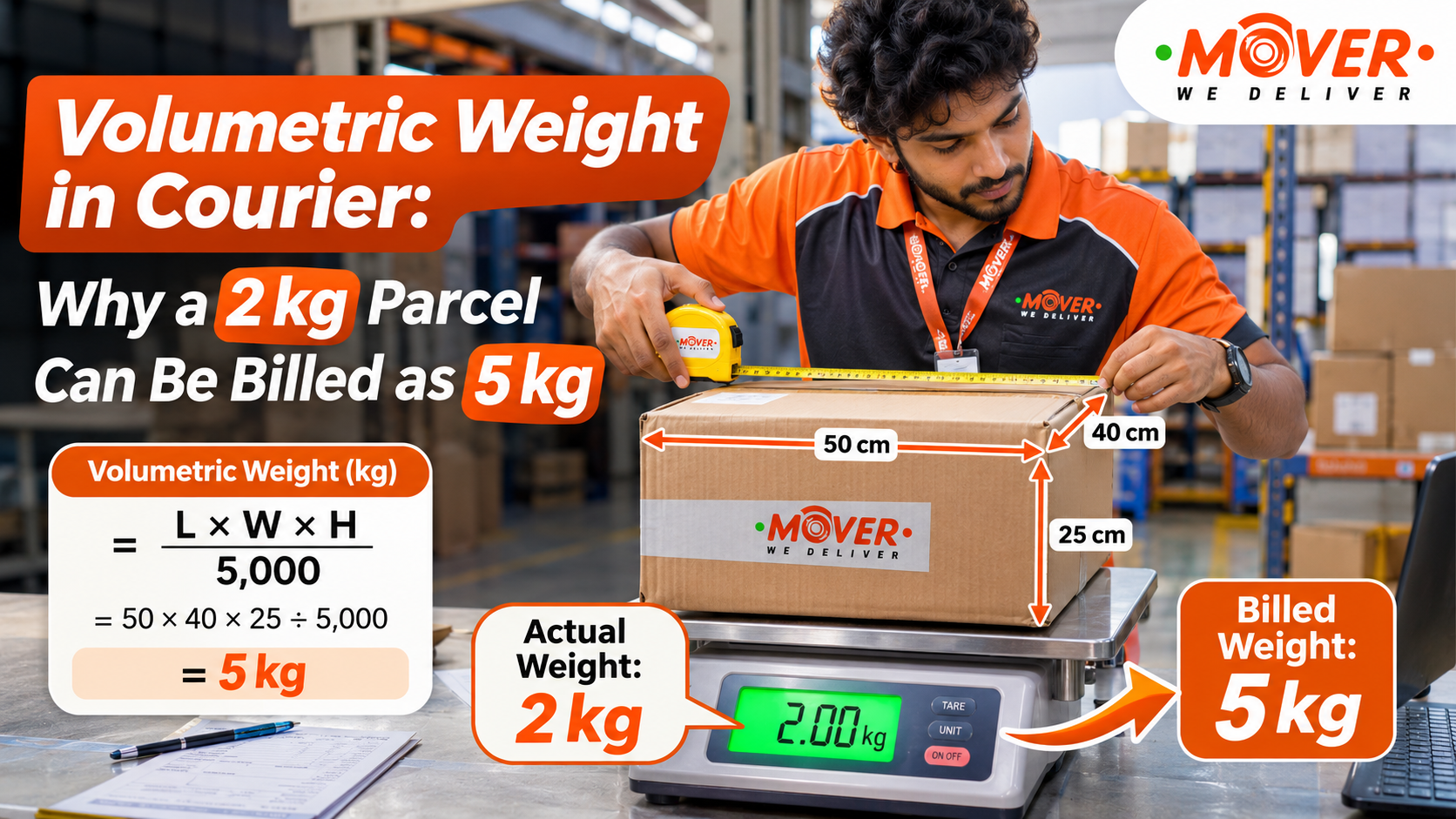

When you send a parcel, you would usually check its weight before asking for a courier quote. Let’s just say that you have packed a few shirts, and then the sealed carton weighs 2 kg. But when you enter the carton size while booking, then you see that the real charge is calculated for 5 kg. You might be wondering why you are being charged for more than the parcel actually weighs.
So the reason can be the space your parcel takes up -pretty simple. A courier service may compare the actual weight with the volumetric weight, which is further calculated from the parcel’s size, and the charge for whichever is higher. So, even if your parcel weighs 2 kg, its size can bring the weight used for billing to 5 kg.
So let’s discuss how this calculation actually works, so that you can have the ability to understand the quote before sending your parcel.
How to calculate Volumetric Weight in kg?
First things first, the measurements should be of the parcel you are actually handing over to the courier. Pack and close the carton, then measure its outside length, width and height in centimetres. Weigh the complete parcel also, because the carton, tape and packing material are part of its actual weight.
For the volumetric weight calculation, you need one more number. It is called the divisor, and your courier service specifies it in its rate details. This number is used to convert the carton’s volume into a weight for billing.
Volumetric Weight (kg) = (Length (cm) x Width (cm) x Height (cm)) ÷ (Divisor)
Volumetric weight (kg) example:
Now, let’s just take the carton of shirts from our example. Suppose we say that it measures 50 cm in length, 25 cm in width and 20 cm in height. So if the service uses a divisor of 5,000, then the calculation will be looking like this:
50 × 25 × 20 ÷ 5,000 = 5 kg
The weighing scale showed 2 kg, so that is the actual weight. The calculation gives 5 kg, so that is the volumetric weight. Under a service that charges for the higher of the two, 5 kg becomes the chargeable weight in this example. You do not have to add 2 kg and 5 kg together.
We have used 5,000 for this example. Before calculating your own shipment, check the divisor for the service you have selected. Its billing slabs and rounding rules can affect the final weight charged too.
When does a smaller box reduce the billed weight?
Suppose your shirts are lying at the bottom of the carton, with a large empty gap above them. In that case, you may be paying for space that the order does not need. If the shirts fit properly in a shallower carton, you can reduce that space without changing what you are sending.
But the same advice will not always reduce the charge. Let’s compare the shirts with a carton of books.
In the table below, both packed shirt parcels are assumed to weigh 2 kg. All three calculations use a divisor of 5,000.
|
What is inside the carton? |
Outside dimensions (cm) |
Actual packed weight |
Volumetric weight |
Weight used before rounding |
|
Shirts in the original carton |
50 × 25 × 20 |
2 kg |
5 kg |
5 kg |
|
The same shirts in a shallower carton |
50 × 25 × 8 |
2 kg |
2 kg |
2 kg |
|
Books in the original carton |
50 × 25 × 20 |
7 kg |
5 kg |
7 kg |
For the shirts, reducing the carton height brings the volumetric weight down to 2 kg. Since the actual weight is also 2 kg, that is the figure used before any rounding.
For the books, the actual weight is already 7 kg. Even if you reduce the empty space, the charge will not fall below 7 kg while the packed parcel still weighs that much under this tariff.
So, before choosing a smaller carton, check which weight is setting the charge. Also make sure that the goods have enough room for the protection they need. If you are sending a breakable item, removing its padding just to reduce the box size can leave you with damaged goods at the other end.
Why two couriers can quote different weights for the same parcel?
Two services can use different divisors, which means the same carton can have a different volumetric weight under each one.
Our original carton takes up 25,000 cubic centimetres. A service using a divisor of 5,000 will calculate it at 5 kg. If another service uses 4,750, the result will be about 5.26 kg, before rounding. These examples show why you need the divisor for your selected service.
The next thing to check is the billing slab. Suppose a service rounds the weight up to the next half kilogram. Under that rule, a calculation of 5.26 kg would be charged at 5.5 kg. The extra amount comes from rounding, even though the parcel’s measurements have stayed the same.
And then there is the price itself. A quote based on 5 kg is not automatically cheaper than one based on 5.5 kg, because the rates for the two services may be different. Compare the final amount for the same pickup and delivery locations and check which service each quote includes.
For a local order, you may also be comparing a courier parcel service with a same-day delivery booking. The time available for delivery and the type of vehicle needed can matter in that comparison. MOVER’s guide to same-day delivery charges explains these other parts of the quote.
If you are considering India Post, its postage calculator lets you check a postal quote using your parcel details. Select Parcel and enter the pickup and delivery PIN codes, packed weight in grams and outside dimensions in centimetres. The amount shown applies to the India Post service you select.
How to check a courier weight discrepancy after pickup?
Let’s say you booked the carton of shirts at a chargeable weight of 5 kg. After pickup, you receive an update showing 6 kg. Before deciding that the parcel has been weighed incorrectly, you need to find out whether the difference came from the scale weight, the measurements or the way the charge was calculated.
You can go through it in this order:
-
First, ask for the weight and dimensions recorded by the courier. Compare those figures with the ones you entered while booking. For example, if you entered a length of 50 cm but the courier recorded 60 cm, the volumetric weight would go from 5 kg to 6 kg with the same width, height and divisor. You would then know that the length is the measurement you need to check.
-
Then check the calculation for the service you booked. If the measurements match yours, look at the divisor and the rounding rule. A result of 5.26 kg being billed at 5.5 kg may be explained by the service’s billing slab. The difference alone does not mean that the charge is wrong.
-
If you still find a mismatch, explain the exact difference when you raise it. Keep the shipment number, original quote and any photos of the sealed parcel ready. A photo of the parcel on the scale helps show its actual weight. Photos with a measuring tape can help show its dimensions, provided both ends and the reading are visible. Submit the details through the courier’s weight-dispute process within its stated time limit.
For future shipments, taking these photos after packing and before pickup can save you from trouble to explain the measurements from memory later.
FAQs about volumetric weight in courier
1. How do I calculate volumetric weight if my measurements are in inches?
Well that’s pretty easy, you can calculate volumetric weight from inch measurements by first converting the length, width and height into centimetres. One inch is roughly like 2.54 cm, so a length of 10 inches becomes 25.4 cm. Once all three measurements are in centimetres, you can use them in the formula with your courier service’s divisor.
2. How do I calculate the weight of two boxes sent in one just order?
For two boxes sent in one order, you will need to weigh and measure each packed box separately. One box may be heavy and compact, while the other may be light but it might just take more space. Then make sure to check how your courier combines the weights and also whether it rounds each box separately before calculating the shipment charge.
3. Does volumetric weight apply if I book a whole vehicle for local delivery?
A whole-vehicle booking may be quoted by the vehicle, distance and time instead of a per-kilogram courier rate, so you should ask how your booking will be charged. The carton sizes still matter because everything needs to fit in the vehicle. If you are deciding between sending a few parcels and booking a vehicle, MOVER’s guide to local parcel options explains the choices.
4. How do I measure a courier bag that bulges in the middle?
A courier bag should be measured after you have filled and sealed it. Measure its full length and width, then measure the thickness at the point where it bulges most. For example, if you have packed a sweatshirt, measuring only the flat seam will miss the space taken up by the folded clothes in the middle.
5. Can I calculate volumetric weight if my supplier gives the carton volume in CBM?
Yes, you can calculate volumetric weight from CBM if the figure is for the outside volume of the packed carton. CBM means cubic metres. For example, 0.025 CBM equals 25,000 cubic centimetres. If your courier uses a divisor of 5,000, dividing 25,000 by 5,000 gives a volumetric weight of 5 kg.