
Arranging a truck is a regular part of running many businesses. If you supply goods to shops, deliver furniture or move stock between locations, you need to know how those deliveries will be handled.
At first, booking each trip separately may be enough. Then, as the work becomes more regular, you may start asking whether a monthly truck rental would suit the business better.
To decide that, look at a normal month of work and the complete price for both arrangements. Let’s go through what you should compare before agreeing to either one.
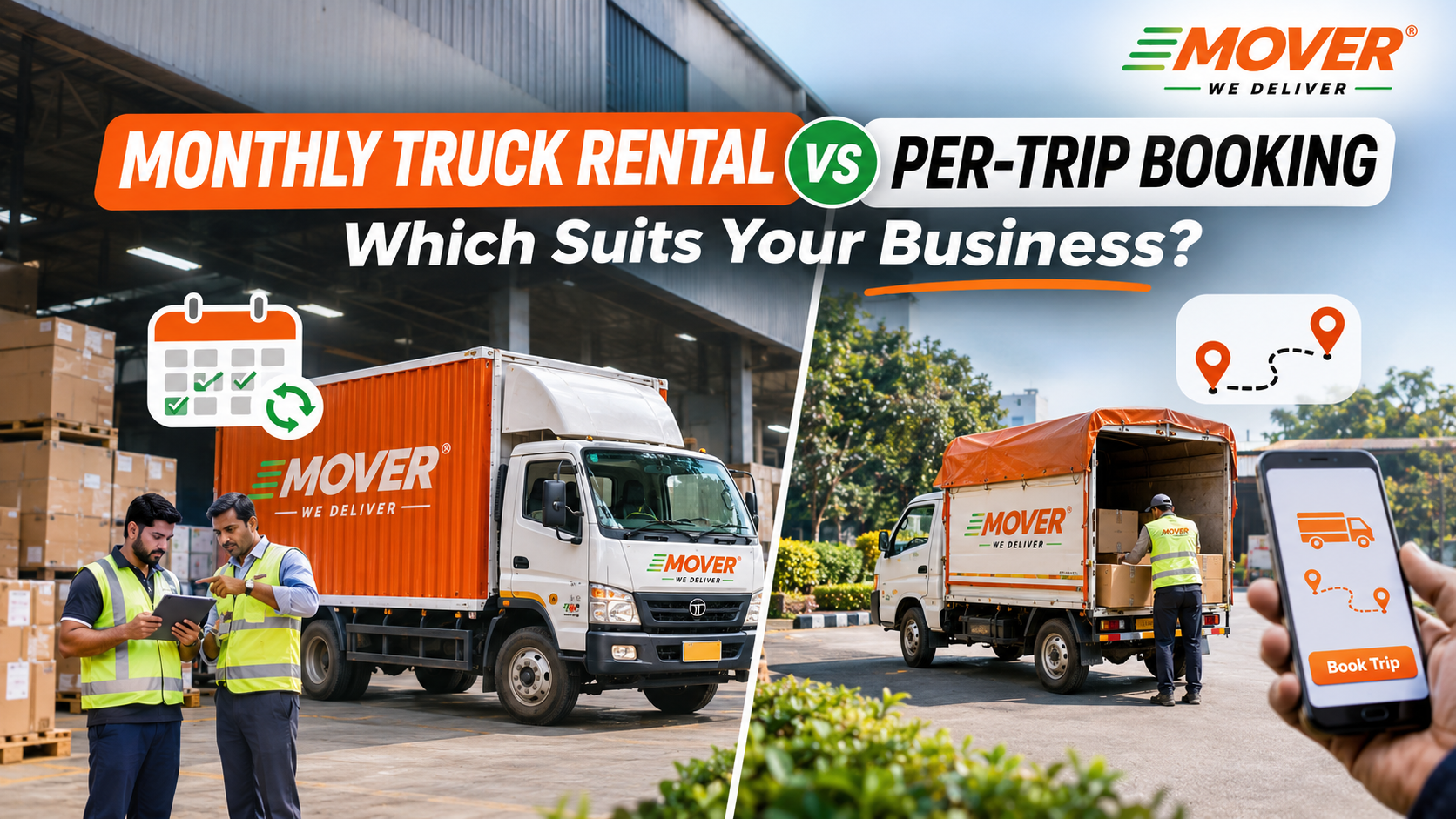
How do monthly rental and per-trip booking work?
With monthly rental, you agree with the provider on the vehicle service you need for a month. The agreement should explain the working days, timings, kilometres and area covered. Also ask whether the vehicle is reserved only for your work during those hours.
Suppose you are considering a Tata Ace on monthly rent for shop deliveries. You need to explain when the first pickup happens, where the vehicle goes and when the daily work normally finishes. The provider can then quote for that requirement.
With per-trip booking, you arrange a vehicle for a particular journey when you need it. Give the complete route and all the stops so that the quote covers the work you are asking for. If one run serves three nearby shops, check whether it can be arranged as one booking.
Monthly Truck Rental vs Per-Trip Truck Booking - An Overview
Here is a quick comparison.
|
What you are checking |
Monthly truck rental |
Per-trip booking |
|
Payment |
You agree on an amount for the specified monthly work. |
You pay for the individual bookings you make. |
|
Working limits |
Check the agreed days, hours, kilometres and service area. |
Check the route, stops and work included in each booking. |
|
Quieter periods |
Ask what remains payable when the vehicle is used less. |
Fewer bookings may reduce spending; cancellation terms still matter for confirmed jobs. |
|
Different vehicle needs |
Ask how a change of vehicle or additional capacity will be handled. |
You can request a suitable vehicle for each job, subject to availability. |
|
Vehicle availability |
Agree what is being reserved and what happens if a replacement is needed. |
Confirm the vehicle and pickup arrangement for each booking. |
There is one billing detail to understand too. A business may receive one bill for all the trips made during the month while still paying for each trip. That does not automatically mean a truck has been reserved for its monthly use.
Start with a normal month of deliveries
Before asking which option is cheaper, put together a picture of the work. Your dispatch records and recent transport bills can help you do this.
-
First, count the days when you actually need a truck. Look at a month that reasonably reflects your business. If you have several quiet days or close on certain days, include that in the discussion. Also explain if the month you are planning for will be busier than usual.
-
Then count the vehicle runs you need. Ten customer orders do not necessarily mean ten separate truck bookings. Some deliveries may fit into the same run if the goods, route and receiving times allow. Work out the journeys before comparing the booking amounts.
-
Write down the complete route. Include any journey back to the warehouse or another pickup after the last delivery. Also ask where the provider starts and stops counting kilometres, so that your estimate and the quotation refer to the same travel.
-
Include the time spent at pickup and delivery. A truck can cover a short distance and still spend a long time waiting to unload. If a warehouse receives goods only during a fixed slot, allow for that on the working day. Understanding appointment-based delivery can help you plan those visits.
-
Check whether the same vehicle suits the usual work. A vehicle that handles your ordinary cartons may not accommodate a larger furniture order. If that happens regularly, ask how a different truck will be arranged and what it will cost.
Once you have these details, give the same requirement to the providers you are comparing. Otherwise, one may quote for a full working day while another has allowed only for a shorter route.
Compare the price for the complete work
Start by checking the driver and fuel. If one amount includes both and another leaves fuel for you to pay, you still need to add that cost before comparing the prices.
When fuel is charged separately, ask how the amount will be calculated and recorded. Use your actual route and operating information when estimating the expense. IndianOil’s fuel-price check explains how to check indicative local petrol and diesel prices. The price at the outlet and the fuel terms agreed with the provider still need to be considered.
Then look at the hours and kilometres included. Ask what happens when the work goes beyond either allowance. For example, if unloading takes longer and the vehicle finishes after the agreed time, you should know how that extra time will be charged.
Also clarify how waiting is counted. It may use part of the reserved working period, attract a separate charge or be treated according to another agreed condition. Get this explained for both arrangements.
After that, check the work around the journey itself. Extra stops, return trips, loading help or a second vehicle may change the amount. Mention these while getting the quote, especially if they are a normal part of your deliveries.
Finally, check relevant tolls, parking, night or holiday work, out-of-area journeys and applicable tax. You should be able to see the amount for the complete work and understand which charges, if any, remain separate.
A simple example using two sample quotes
Suppose you are comparing a monthly amount of ₹48,000 with ₹1,200 for each comparable booking. We are using made-up figures here to explain the calculation.
For this example, the driver and fuel are included in both prices, and all the journeys fit within the monthly arrangement’s agreed hours, kilometres and other conditions. The amounts below are before tax and any work outside that agreed scope.
|
Comparable bookings during the month |
Per-trip total at ₹1,200 |
Monthly sample amount |
|
20 |
₹24,000 |
₹48,000 |
|
40 |
₹48,000 |
₹48,000 |
|
50 |
₹60,000 |
₹48,000 |
In this example, the two amounts become equal at 40 bookings. With fewer bookings, the per-trip total is lower. With more bookings, the monthly amount is lower, provided the work remains covered by that agreement.
This is why you should look at a quieter month also. If you expect plenty of deliveries but receive fewer orders, the monthly amount you have committed to may still be payable.
There is another thing to check before choosing the monthly option. If the busier month needs extra hours, kilometres or another vehicle, will ₹48,000 still cover it? Add those costs before deciding.
For your own business, use the actual quotes. If different trips have different prices, add those expected booking amounts rather than assuming every journey will cost the same. The point at which the two options cost the same will change with those details.
Monthly Truck Rental vs Per-Trip Booking - Which arrangement fits your delivery pattern?
The price comparison helps, but the arrangement also needs to suit how the business works. Let’s look at three ordinary situations.
1. You have regular work on most operating days
Suppose you distribute goods to a reasonably stable set of shops. The pickup starts around the same time, the vehicle requirement is consistent and you can explain the usual daily route.
In this situation, a monthly arrangement is worth comparing because you have regular work for the reserved vehicle service. Check whether the agreed working period covers the complete run, including the time at each delivery point.
Daily use is a good reason to ask for a monthly quote. You still need to compare that quote with the cost of booking the same work separately.
2. Your deliveries change from week to week
Now suppose you run a furniture shop. Some weeks have several deliveries, while other weeks have very few. A small order may need one vehicle, and a large dining set may need another.
Per-trip booking might just suit this changing requirement because you can then request transport around the orders you receive. And you can also discuss the vehicle needed for each load.
Still, plan the pickup with enough notice for the provider to check availability. A flexible booking arrangement does not remove the need to confirm the vehicle before promising a delivery time to your customer.
Most work is regular, but you have busier days
You may have enough ordinary work to discuss a monthly arrangement and still need another vehicle during a sale or a larger stock movement.
In that case, ask about using a monthly arrangement for the regular work and making extra bookings when needed. Compare the combined cost and find out how much notice is needed for the additional vehicle.
This can be discussed as part of your requirement. The provider needs to confirm what can actually be offered for your location and workload.
What to agree before confirming the arrangement
Once you have compared the work and the prices, get the service details written down. Let’s discuss the points that need to be clear.
-
Agree when and where the vehicle will work. The arrangement should state the operating days, start and finish times and service area. If you sometimes need an earlier pickup or work on a holiday, ask how that change should be requested.
-
Find out what vehicle service is being reserved. Ask whether a particular truck or a suitable vehicle category will be assigned, and whether it is exclusive to your work during the agreed hours. Also ask who will arrange a replacement if the truck or driver cannot attend.
-
Explain the help needed with the goods. Driving the vehicle and loading the goods are different parts of the job. If you need a helper, carrying assistance or unloading support, get that included in the discussion and quotation.
-
Agree how the work will be recorded. Keep the trip details, kilometres and timings needed to check the bill. If an extra charge appears, then these records make it easier for you to understand which journey or period it relates itself to.
-
Check the payment and commitment terms. Ask about any advance or deposit, or when payment is due and how long you are committing for. Also find out what notice is needed if you want to reduce the work, make sure to change the arrangement or stop using it.
Keep the quotation and written terms together. The booking checklist covers further checks for the vehicle, route, booking and payment.
To discuss business delivery options with MOVER, share your city, goods, vehicle requirement and also normal working pattern. Include the usual routes, kilometres, hours and any extra demand you expect on busy days. The team can then review the requirement and also explain which arrangements can be offered and what the quote includes for you.
FAQs about Monthly truck rental & Per-trip Truck booking
1. How many trips make monthly truck rental worthwhile?
There is no single trip count that applies to every business. Compare the complete monthly quote with what the same work would cost through separate bookings. Also check whether the monthly hours and kilometres are enough for those journeys.
2. Does monthly truck rental include the driver and fuel?
Ask the provider to write down whether the monthly price includes the driver and fuel. If either is separate, get the amount or the way it will be calculated clarified before comparing the quotes.
3. Can one per-trip booking include multiple delivery stops?
Yes, one booking can include several delivery stops where the provider supports that arrangement. Share all the stops before booking, so that the route, vehicle and price can be worked out for the complete job.
4. Do I still pay for days when I do not use the truck?
If you have agreed to a fixed monthly payment, you may still need to pay it on days when the truck is unused. Ask how Sundays, holidays and a longer business closure will be treated before confirming the arrangement.
5. Is monthly billing the same as monthly truck rental?
No, monthly billing and monthly truck rental are different. With monthly billing, the individual trips you make may be collected into one bill. With monthly rental, you agree to a month of vehicle service under specified working conditions.
6. What happens if the assigned truck or driver is unavailable?
Ask the provider what replacement arrangement they will offer and get it written down before booking. Also keep the contact of the person handling the arrangement, so that you know whom to call if the vehicle or driver cannot attend.